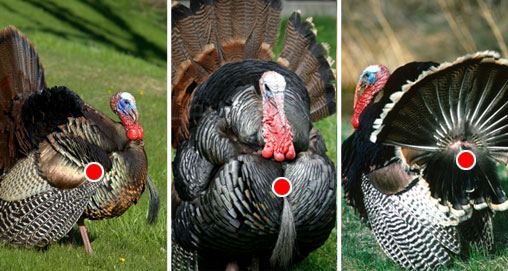
A wild turkey’s vital area is only about the size of a softball, making precise arrow placement a must. To make the shot you have to practice properly, but also know exactly where to aim on that mass of feathers.
Practice: Three Points to Remember
1. Rarely, if ever, do you get a bow shot at a turkey from the standing position. Most archery gobblers are taken from inside a blind of some kind, meaning you’ll be seated. If you are outside the blind and sneaking about, often you’ll end up shooting from your knees. If you hunt like this, practice your shooting accordingly. I find I have a tendency to shoot a bit high when kneeling or seated in a chair inside a blind. It takes a while for me to get dialed in.
2.Practice shooting at either a life-sized 3-D turkey target or a turkey silhouette. Bull’s eye shooting is the best way to get your sight pins set and work on shooting form, but the final preparation is best done on something that emulates the real thing.
3.Use a bow set at a lighter draw weight than you would use when hunting big game. This will help you hold at full draw for an extended period of time before tiring, something turkey hunters often have to do. I turn my own bows down about 10 percent, but I have friends who will reduce pull weight by 20 percent.
Where to aim?
If the bird is broadside, I aim for the wing butt. This will both break the wing(s), which will keep him from flying off, while penetrating both lungs. If the bird is facing me in full strut, I aim for the top of his beard. If he is facing me but not strutting, in a more erect posture, I aim for the top third of the beard. If a bird is strutting and facing away from me, I aim for the center of his fan, just about the base.
The one shot I do not advocate and never take is the head shot. It may be tempting but rarely is a gobbler’s head not in motion, making it doubly difficult to hit this small target.
How far away should you shoot?
That’s an individual determination, dependent on your own shooting skills and the position and attitude of the bird. When hunting from a blind, I set decoys at about 15 yards from the blind so that any approaching gobbler that stops short of the deke will be about 20 yards off. Anything inside that range is point blank for me. The farthest away I have ever killed a gobbler with an arrow is 40 yards, but the planets were lined up in terms of bird posture and attitude, no wind and no other altered birds. Generally speaking, though, I limit my own bow shots at gobblers to 30 yards or less—and like it a whole lot better if they are half that distance.