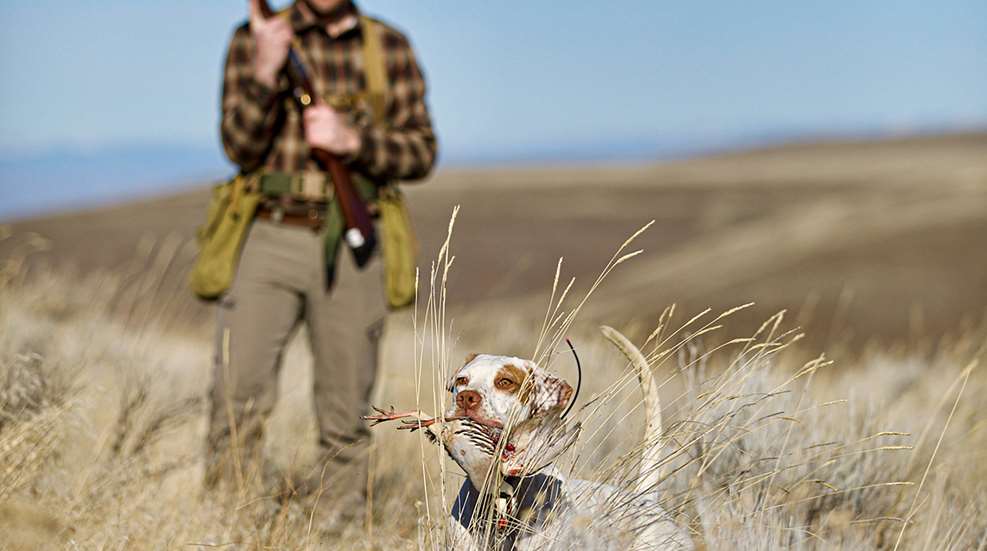
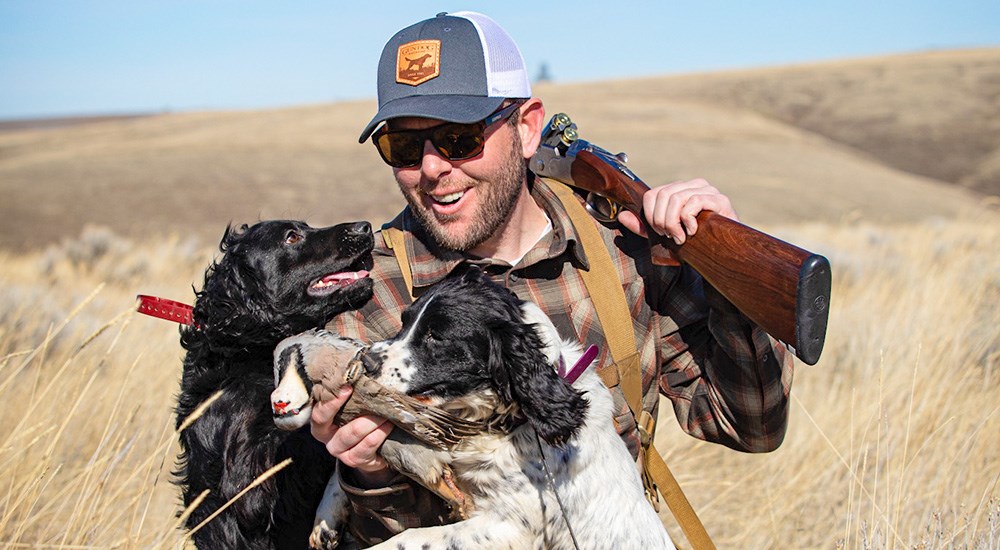
There was no doubt that my Labrador’s nostrils were filled with fresh bird scent as they frantically quartered the hillside above me. I knew what was coming, yet the flurry of feathers from a trio of wild chukar erupting skyward still caught me off guard, momentarily dissipating my aching knees, sore feet and burning lungs. Both barrels from my 20-gauge Browning Citori barked, tumbling a brace of fleeing partridge back down the hillside I had just ascended. The dogs handsomely marked the fallen chukar and retrieved both to hand. Admiring the striking birds, a satisfying sense of self-fulfillment and gratitude for a successful hunt seeped in. Walking back to the truck it dawned on me that the self-inflicted physical and mental abuse of pursuing wild chukar is precisely what sets them apart from other bird hunting endeavors. For many upland enthusiasts, the chukar represents the pinnacle of Western upland bird hunting.
Often referred to as the “devil bird,” chukar are notoriously high-desert dwellers, thriving in some of the most rugged and unforgiving country in the Lower 48. Fortunately, unlike many other upland species, the vast majority of chukar populations throughout the West can be found scattered across millions of acres of accessible public land. Nevada always has and always will be Mecca for the serious chukar hunter with stable populations, liberal bag limits, extended season dates and millions of acres of prime chukar hunting real estate. Healthy, huntable populations also thrive in parts of California, Oregon, Washington, Utah, Idaho, Montana and Wyoming.
Die-hard chukar hunters are a passionate niche of upland enthusiasts and also one of the most secretive. Asking an avid chukar hunter where to go will likely result in an awkward laugh and a vague response. Finding chukars can feel like a daunting task, but I promise the reward is worth the effort.
Narrowing down where to find coveys of birds will require some time and trial by error, but the first and most important element to finding chukars, especially before the snow falls, is water. Search out small springs, streams and even manmade water guzzlers where natural water is non-existent. This can be done via e-scouting, poring over maps, speaking to local biologists or good old-fashioned boots on the ground knowledge.
Chukars primarily thrive on steep, golden cheat grass-covered mountains laced with ribbons of rocky cliff lines. Scattered sage brush and cedar trees are also a common refuge for wild chukars. Coveys of birds can be found from the top of the mountain to the valley floor, but focus your time and efforts along natural benches, cliff bands and windswept ridge tops once the snow flies.
When possible, hunt chukars from the top of the mountain and work your way down. Their natural tendency is to run uphill, but I promise none of us have the physical abilities to keep up with a running chukar moving up a vertical hillside. Also, when you hunt them from above, they are more likely to hold and rise within the effective range of a scattergun. On that note, a covey of chukar almost always rises in a staggered pattern. If I had a dollar for every time I emptied my shotgun at birds on the edge of range, only to have a straggler or two jump at my feet, I would be a rich man. I typically hunt upland birds with my trusty 20-gauge Browning Citori, but often lean toward carrying a light semi-auto such as my 28-gauge Benelli Super Black Eagle when hunting chukars. Doing so provides an extra shot or two on staggered covey rises. The synthetic stock of my SBE also braves the dings and scratches that come with hiking mountainous terrain far better than my Citori.
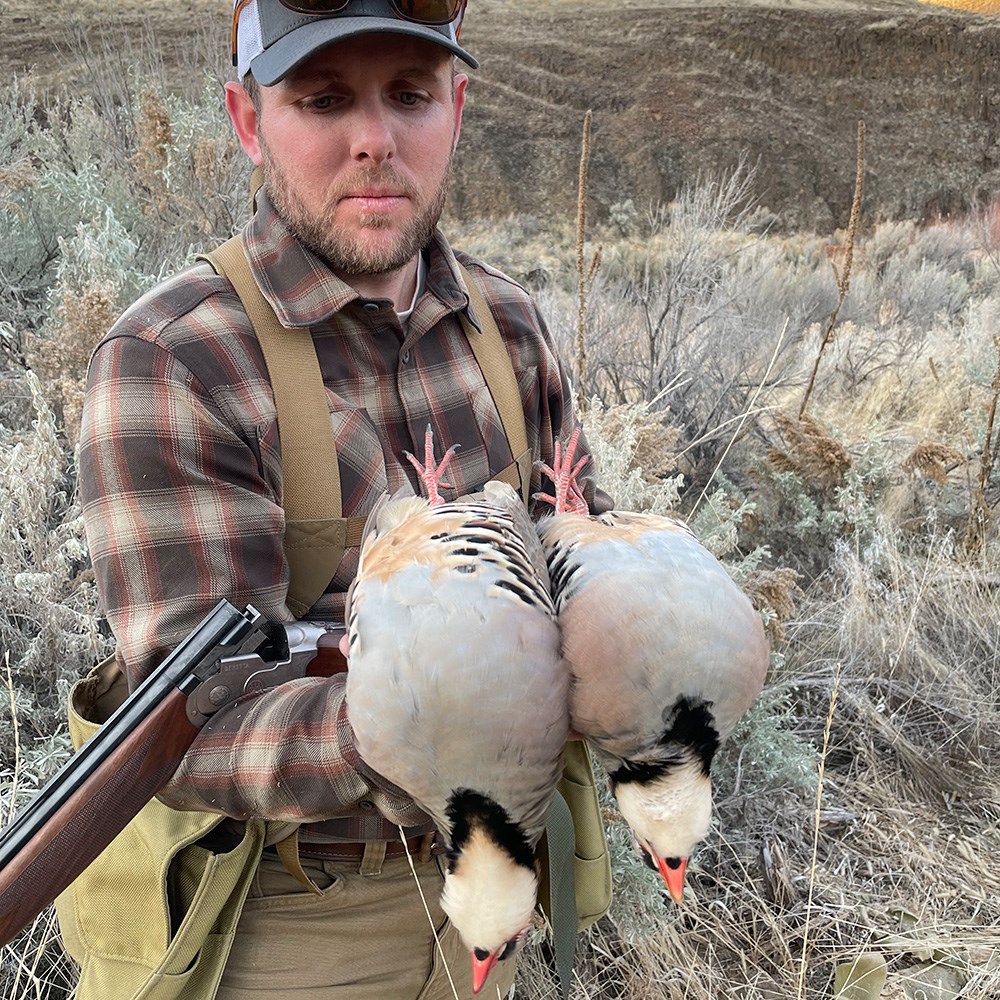 Chukars are larger than quail, smaller than pheasants; No. 5 or No. 7 shot from a 20-gauge should do the job.
Size-wise, chukars fall smack in the middle between a pheasant and a quail and are not difficult to bring down. Fairly open choke tubes are the norm, but any choke/load combination that produces an effective pattern out of your shotgun will suffice. Most lead loads will knock birds out of the sky with plenty of authority, but chukar hunters tend to lean towards a payload of No. 5 to No. 7 shot out of a sub-gauge scattergun. Last fall, I primarily shot Federal Premium’s 20-gauge Prairie Storm FS Lead loaded with No. 5 shot and was nothing but impressed with its performance.
The social structure of a covey of chukars can also be their demise. After the chaos of a covey rise, birds disperse in every direction. Breaking up the covey allows for good follow-up opportunities as singles and pairs typically hold tighter than a covey. Chukars will also begin “chucking” to bring the covey back together after they are scattered. Their taunting “chucks” give away the general direction of their location, usually back down at the bottom of the mountain you just climbed. One other thing to keep in mind once you find birds is to always be cognizant of the bird numbers in a given covey. Shoot a bird or two and continue your search for another covey. If you implement this practice, and keep tedious notes of a covey’s location, you will be able to come back and hunt birds in that area for years to come.
Chukar hunting is not for the faint of heart, but if you are up for the challenge, there is no upland endeavor more rewarding than pursuing the devil’s bird across the vast expanses of public land across the West. One taste of success and you will be smitten with the same obsession that chasing these masked bandits has inflicted on so many passionate chukar hunters! You’ve been warned.