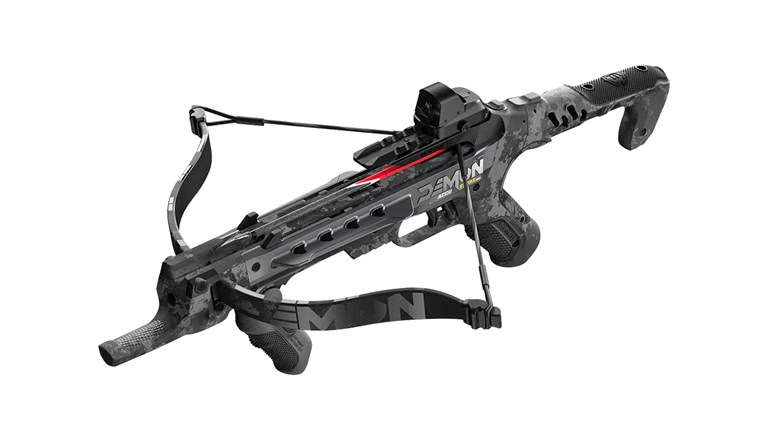
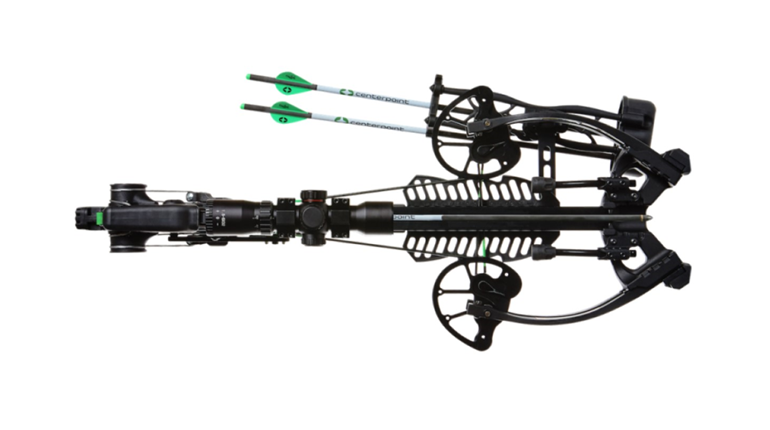
Recently I went to a local archery range and quickly learned that the president of said range is a traditional archer. When I broke out my new PSE crossbow to practice for the upcoming archery season—crossbows are legal means for Virginia’s regular archery seasons—he got in my face and told me that crossbows were not allowed at the range. When I asked him why, he told me that crossbows “destroy the targets because they are so powerful.” I believe he has a bias against crossbows because my offer to bring and use my own portable target didn’t sway him. I didn’t shoot my crossbow that day, but I called 1-800-Bullshooters on that archery snob and began a mission to find the facts.
The Question: Does the average modern crossbow deliver more kinetic energy to the target than the average modern compound bow?
The Math: To find the answer, I chronographed four popular crossbows—using factory recommended bolt weights and point weights—and found the average kenetic energy for modern crossbows. Then I compared the numbers to the average kinetic energy produced by popular modern compound bows using the most popular arrow and point weights.
*Crossbow speeds and draw weights vary by model, but individual units of the same model generally shoot the same draw weight, draw length and arrow size, therefore speed and energy is very close.
*Compound bow speeds and energies, on the other hand, vary wildly because most are highly adjustable and therefore each shooter selects a customized draw weight, draw length and arrow length and weight, which all contribute to the arrow’s speed and energy.
So, to find a general answer to this general question, I asked experts at archery manufacturing giant PSE what the average compound bow typically sold would be. Blake Shelby said a typical modern compound bow has a 65-pound draw weight, drawing a 29-inch, 400-grain arrow that averages 285 fps. from a new, top-end bow.
The Data:
Crossbow average kinetic energy average: 327 fps / 420 grains = 99.747 KE
Specific crossbow setups (with varying draw lengths and weights for comparison purposes):
-Wicked Ridge Invader: 297 fps / 445 grains KE = 87.18
-Stryker Strykzone 380: 375 fps / 395 grains KE= 123.37
-Parker Concord: 293 fps / 415 grains. KE= 79.12
-PSE Tac 10: 341 fps / 425 grains KE= 109.76
Vertical compound bow kinetic energy average: 285 fps / 400 grains = 72.16 KE
Specific compound bow setups (with varying draw lengths and weights for comparison purposes):
-PSE Dream Season EVO: 65 # @ 311 fps / 375 grains KE= 80.55
-Darton DS 3800: 72 # @ 344 fps / 348 grains KE= 91.46
-Bowtech Invasion: 59 # @ 276 fps / 385 grains KE= 65.13
-Mathews Z7: 59 # @ 272 fps / 385 grains KE= 63.26
There are many things involved here, including draw weights, power stroke lengths, shooting techniques, arrow rests, etc., but on average, modern crossbows deliver more energy than modern compound bows. The difference is negligible however, especially when compared to a modern rifle (a .30-06 with a 150-grain bullet delivers a muzzle energy of about 2,800), so this comparison isn’t to suggest that crossbows can be used effectively at greater ranges than compound bows. With cutting-edge archery technology, shot placement is absolutely critical, and the bow is only as effective as the shooter. Nonetheless, the snobby traditional archer was right—a crossbow does have a little more energy than the average compound bow—but his argument that crossbows will destroy the targets moreso than any other bow is highly questionable. I smell another Bullshooters article brewing.
The Answer: The average modern crossbows delivers slightly more kinetic energy than the average modern compound bow.