On March 5, 2025, I joined three colleagues on a trip to Mangum, Okla., for our first-ever wild hog hunt. With tales of sounders 120 strong, we arrived full of anticipation and settled into deer blinds baited and ready, courtesy of the landowner—a close friend of one of our group. He assured us we’d see hogs around sunset.
But as night fell, the only wildlife we spotted was a covey of quail and a pair of skunks. Not quite the chaos we’d envisioned.
Undeterred, we were up by 5 a.m. the next morning, fueled by renewed hope and stories of massive sounders “bigger than two Army platoons.” We scouted the fields but saw only a single boar running through the brush as 400 yards and, once again, more skunks. Still, we pressed on.
By 8 a.m., we shifted strategy, opting to cover more ground by vehicle. We spent hours navigating the rugged, rolling terrain of southern Oklahoma. The landscape told a promising story—tracks, rooting, wallows everywhere—but the hogs remained elusive. We spotted three lone hogs, each well out of range. One teammate managed to ventilate a coyote, which added a dash of excitement to an otherwise fruitless morning.
Lunch with some locals, including a state conservation officer, gave us new insights. He suggested we explore the bluffs, so we set off on foot, trekking miles through mesquite-choked river valleys. We saw deer, more hog sign than I could count … and, of course, more skunks. Still no sounders.
By late afternoon, two teammates had tapped out. They headed to town to relax and enjoy dinner with friends. With just one opportunity left before we returned home, two of us weren’t ready to give up.
We returned to the original blinds, hoping for a final shot at redemption. The road ended nearly a mile from the stands, which sat across a flowing seasonal creek. The wind had picked up, stirring tumbleweeds and dust into an onslaught of debris that slowed progress. The sunset that had painted the sky the night before was now muted to a faint glow behind a wall of haze.
I arrived with 38 minutes of shooting light left. Immediately, I noticed the corn we had placed earlier was gone. A sinking feeling hit me. I’ve missed the show, I thought, and mentally kicked myself for being late. In my rush to get to the blind, I grabbed the .243 deer rifle I had loaned to my friend—the one who was now dining in town—and left everything else behind.
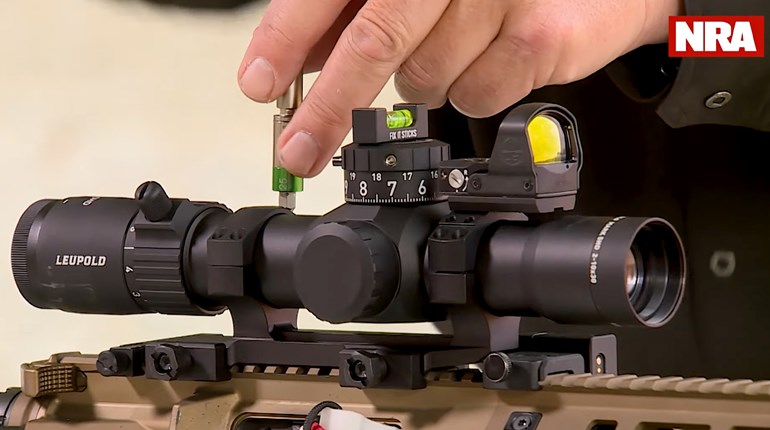
Despite my exhaustion from the long day, there was something peaceful about being alone in God’s creation for a few minutes after two days of hunting with friends. The sun set at 6:36 p.m., and by 6:56 p.m. the clouds and dust had turned the landscape into something barely perceptible through the Leopold. As I was about to close the window, I saw something odd—what looked like tumbleweeds rolling into the wind. A minute later, a massive sounder, easily 100 hogs strong, stormed through the food plot a mere 100 yards away. They moved fast and did not stop, likely catching wind of me or sensing there was no corn left. Just as quickly as they appeared, they began to pass through—until one large sow hesitated. I had just enough light and contrast through the Leopold to settle the crosshairs and fire. A clean shot. A squeal split the air as the rest thundered north, toward the river.
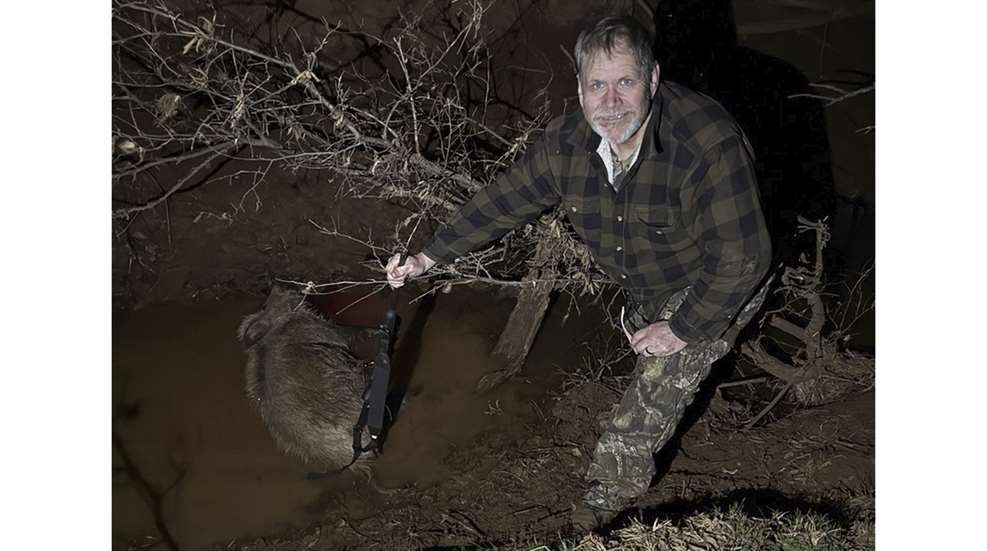
I wished I’d brought my sidearm—until that hunt, it had never left my hip. I shut the blind’s window, flicked on the headlamp clipped to my cap and started toward the downed hog. But at 30 yards, she bolted. She ran another 30 yards, paused, then dashed another 40 into a deep ravine. There, in the muddy creek, she expired.
My colleague arrived just after I reached the ravine. We were exhausted and dusty, but beaming. After two days of hard hunting, we had our success.
Later that night, our host invited us back later in the year for a combo hunt—hogs and turkey, or maybe hogs and deer. One or both, I know I will be back. As we drove back to town, the image of that “sea of hogs” kept replaying in my mind. It’s a sight I’ll never forget—and a memory I’ll cherish for years to come.