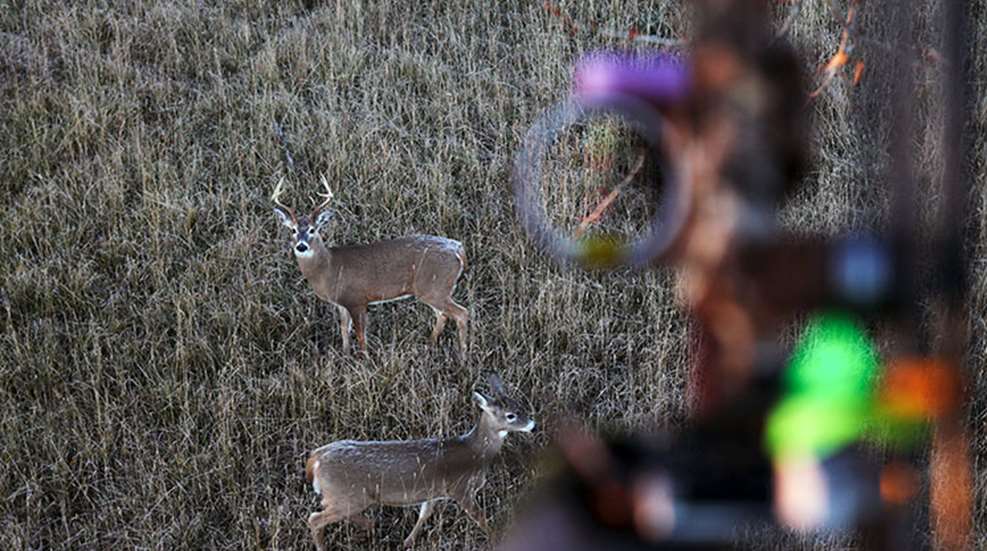
Every time I hear a story about a world-champion target archer missing a deer I crack up. Misses happen because unlike on target ranges, treestands lean, limbs sway across shooting lanes, deer move when they shouldn’t, and human hearts pound when the target wears fur. While nothing can replace experience, there are a few things bowhunters can do to better prepare both mentally and physically for the moment of truth. One is to shoot faster.
On the target range we have all day to assume a perfect stance, draw, nestle into our anchor point, check the level, center the sight ring, pick a pin, and then concentrate on breathing and a perfect release. But bucks rarely stay still for long. So you should learn to draw, aim and shoot swiftly and accurately with little conscious thought.
Practice on the range—or better yet from your treestand—by envisioning a buck walking into and stopping in your shooting lane (where you placed your target). While keeping both eyes open and your arrow pointed at the imaginary deer, draw straight back swiftly and smoothly.
Grunt with your voice to stop the “deer” just as you would if it were real, and initiate a mental countdown by saying a phrase in your head as a cue to release. You might as well pick a phrase that helps you shoot better. For example, I draw and think pick a spot, squeeze the trigger, follow through. This takes about three seconds. I shoot the moment after I finish the word “through.”
Practicing such a shot sequence builds consistency and therefore accuracy, just as a consistent backswing does for golfers. Although at first this self-induced timer can make you nervous, through repetition you’ll learn to paste the pin on the animal’s vitals, steady your hold and execute the shot. The key is actually doing what you tell yourself and squeezing the release, rather than slapping it. Pretty soon your sequence will instill calmness.
Once your swift shot sequence becomes routine, a level of subconsciousness can take over that will help reduce self-doubt initiated from overthinking. Certainly, shooting fast reduces the time available for a buck to move out of the kill zone, and that alone increases your odds of nailing him clean.