In days past you’d need bluing tanks and all the toxic chemicals that the process entails. While bluing is still an excellent way to finish a rifle, the hobby gunsmith will likely have better results with spray-on coatings. Spray-on coatings can also provide a wide range of options for colors and finishes. There are several coating-type metal finishes on the market, but most require oven drying, which can be a problem for a hobby gunsmith.
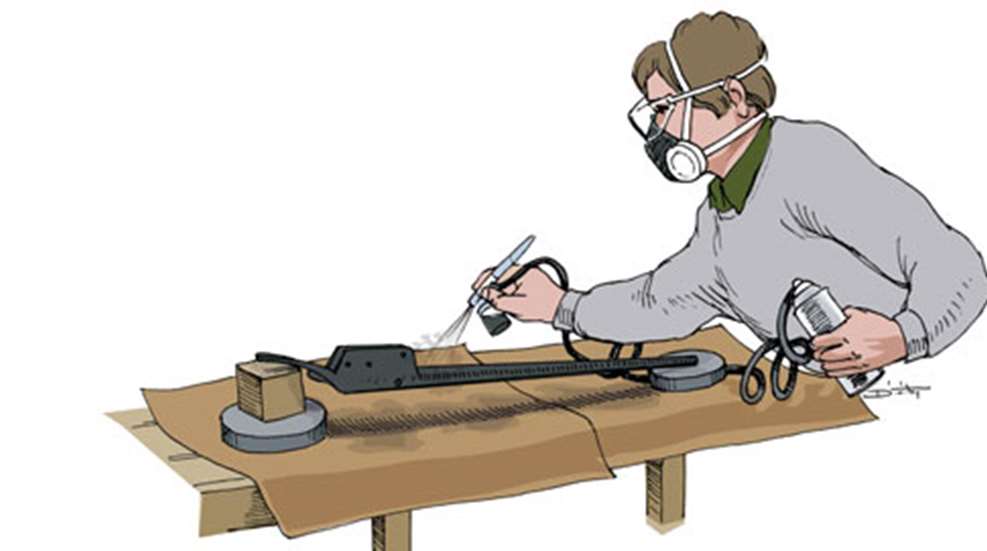
It’s better to use an air-dry coating. Two products I’ve used with good success are DuraCoat by Lauer Custom Weaponry, and Aluma-Hyde II from Brownells. DuraCoat is used with a spray gun or an airbrush. The company offers a kit that includes an airbrush for about $50. Aluma-Hyde comes in a convenient spray can or as a liquid for use with an airbrush or sprayer.
1. Remove the stock and any scope, mounts or sights. Disassemble the firearm as far as you are comfortable—the smaller the parts, the better. Remove anything you do not wish to coat. Cover and protect anything with masking tape that can’t be removed.
2. The coatings can be applied over just about any clean surface. The best approach is to sandblast the metal parts that will be coated. The rough surface from sandblasting actually increases surface area for the coating to grip and gives it “tooth.” If you don’t have access to a sandblaster, it also works to just rough up the metal with a Scotch-Brite pad or sandpaper.
3. All the metal must be degreased with a solvent that dries without residue. This can be done with an aerosol-degreasing agent or by soaking in a tank full of degreaser. This is a very important step and must be done correctly for good results. Only handle the metal with clean cotton gloves after degreasing.
4. It is a simple matter to follow the application directions with these products. The key is to use several thin coatings instead of a single thick application.
5. After coating the metal, let it set undisturbed for at least 24 hours. After that, the parts can be handled, but it may take a week or longer for the coating to reach its full hardness. (Signed copies of Bryce M. Towsley’s book Gunsmithing Made Easy is available from The Outside Connection Inc., 58 Sonia Lane, North Clarendon, VT 05759; 802-775-7269; www.brycetowsley.com; Visa or MasterCard accepted; $12.49 plus $4.95 for S&H.)
Materials/Tools
❑ Screwdriver and wrenches
❑ DuraCoat or Aluma-Hyde
❑ Airbrush and propellant (unless using a self-propelled product like Aluma-Hyde)
❑ Degreasing solvent
❑ Clean cotton gloves
❑ Sand blaster or sandpaper and Scotch-Brite
❑ Painting mask or respirator
❑ Safety glasses
❑ Wire to suspend parts