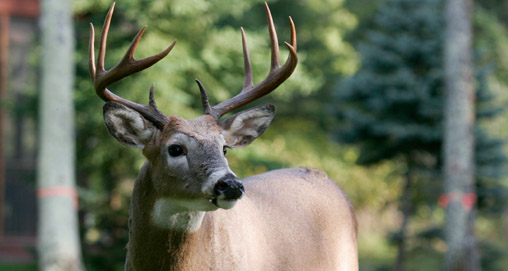
Some wildlife biologists worry the whitetail, the backbone of American hunting, is running tail-flagging for a crash. Doctor Grant Woods, a consulting wildlife biologist who assesses deer herds all over the country, has said, “I think we’re nearing a crisis mode. The best-case scenario is that deer populations drop 10 to 25 percent over the next couple years.”
The thing is, according to numbers crunched by the Quality Deer Management Association (QDMA), whitetail populations in North America already have fallen by about 10 percent since 2008. In 2008 the QDMA estimated there were between 32-33 million whitetails; now the QDMA estimates there are closer to 30 million. If those estimates are accurate and projected forward, it’s conceivable the population could fall toward 20 million.
Increasing predator populations, commodity prices, disease outbreaks and aging habitat in the Northeast and parts of the South are factors making some worry this might be the beginning of a precipitous check in what has been, in many areas, an over-populated herd. Most biologists, however, see this as a much more complex and localized issue.
Brian Murphy, CEO of the QDMA and a wildlife biologist, doesn’t think the whitetail is headed for a crash. “We’re just entering a period many didn’t foresee,” he says. “Instead of the surging whitetail numbers of the 1990s and early 2000s, we’re seeing stable to slightly declining populations in many regions as populations fall in line with habitat.”
Murphy also points out that over the last few decades the quality-deer management concept has been experimented with in many states. In 2011, 22 states utilized some kind of an antler-point restriction; eight of them had statewide restrictions. Meanwhile, 10 states had “earn-a-buck” regulations in parts or all of their states.
“Earn-a-buck regulations are highly effective at increasing antlerless harvests,” notes the QDMA’s Whitetail Report 2012 (QDMA.com), “but are widely unpopular among hunters.”
Reducing herds also can be unpopular. Early in the 20th century America’s hunters footed the bill for much of the whitetail’s comeback and now are actively utilized to manage North America’s game. But the controversy over population goals aside, to some extent the lower overall whitetail population has been accomplished by design.
Beyond the sometimes-controversial measures taken by state game agencies to reduce herds, a few factors affect deer populations that wildlife managers aren’t completely sure how to factor in, and it’s these factors some biologists fear.
Disease Outbreaks
Whitetail hunters drive the hunting industry. According to the U.S. Fish and Wildlife Service, there are about 12 million deer hunters in the United States. The licenses they buy raise about $600 million annually for state wildlife agencies, and the gear they buy generates $12.4 billion for the American economy. So when a deer herd dies off, it’s not just hunters who worry. Die-offs occurred in many parts of the country during the summer of 2011. Outbreaks of hemorrhagic disease (HD) in whitetail herds took place from North Carolina to Montana. HD is the most significant viral disease that impacts whitetails annually. It is an infectious, blood-borne disease of deer and elk transmitted by biting midges or flies; it is caused by either of two closely related viruses, epizootic hemorrhagic disease (EHD) virus or bluetongue (BTV) virus. According to the Southeastern Cooperative Wildlife Disease Study (SCWDS), in 2011 18 states reported suspected cases of HD. When HD occurs, massive die-offs can take place in segments of the overall population.
Predators on the Increase
A recent five-year study on fawn survival on the Savannah River, led by Forest Service researcher Dr. John Kilgo, indicated that less than a quarter of whitetail fawns born in the spring live until autumn. The study used radio transmitters implanted in the female parts of adult does, which were pushed out at birth. When a signal indicated a birth occurred researchers headed to the site. They fitted live fawns with GPS collars, and otherwise determined cause of death. At the end of the study researchers concluded coyotes were the biggest factor in this 75 percent fawn mortality. The researchers’ conclusion: The Savannah River deer herd can sustain itself with this predation, but only if hunter opportunity is diminished.So is the Savannah River predation rate an anomaly?
Overall, the average fawn survival rate declined significantly from 2000-2010. The QDMA says, according to state statistics, the rate (to 6 months) was .81 fawns per adult doe in 2000 but just .66 in 2010. Regionally, it varied. In Michigan just .39 fawns made it to 6 months whereas in Iowa 1.3 per doe lived until fall. In the Northeast, Maine had the highest fawn recruitment rate (.75), followed by Pennsylvania (.70).
Aging Habitat
A 2010 study on land-use changes across the whitetail’s range done by Mark A. Drummond of the U.S. Geological Survey indicated forestland in the Northeast decreased by an estimated 4.1 percent from 1973-2000, mostly due to urban development. Meanwhile, much of the forest cover across Appalachia has been aging due to massive reductions in acres logged by timber companies in New England and New York, and lawsuits against states that thin or clear-cut portions of forests. This is a big factor because while a young hardwood forest can produce 1,000 pounds or more of deer food per acre, a mature forest produces much less—some studies indicate as little as only 50-100 pounds per acre.
“This, more than any other factor,” says Murphy, “is something we can change by lobbying our state agencies to manage public lands not just for trees, but also for wildlife.”
The Future of Deer Management
This last point leads to a frightening diversion of opportunity. Historically, hunting on public land was comparable to that on private land, but over the last few decades this has been changing. Now the discrepancy in quality is widening as habitat generally ages on public land. As public lands become less diverse ecosystems, private landowners tend to do a better job improving habitat, so much so that, incredibly, from 2000-2009, hunters logged a record 4,423 whitetail bucks with the Boone & Crockett Club. These 4,423 bucks make up nearly 40 percent of all the whitetails in the club’s book.
Though herd management is a very regional issue and antler size is not necessarily a measure of a quality experience, it is certainly true that the next great movement in deer hunting needs to be centered on how game managers can improve the quality of the environments on public lands. If this doesn’t occur, deer hunting as an American pastime could decline substantially.