Beyond the classroom or some friendly advice there are several excellent books and videos on the market that can help get you started. Whatever route you choose, you will need some basic tools to get started.
The Press
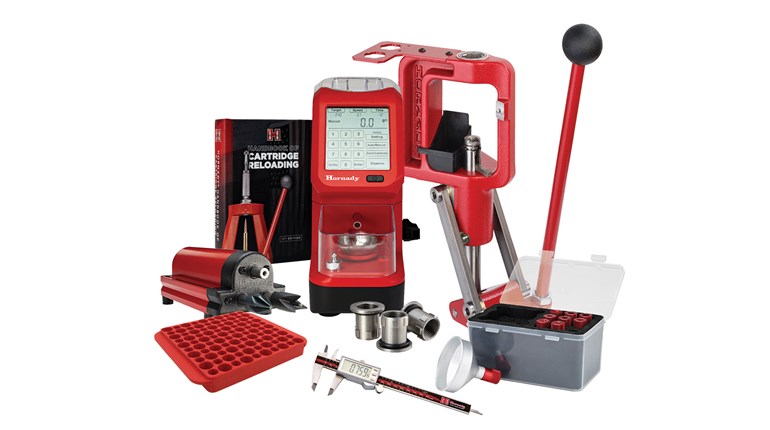
The foundation to handloading is a press. Don't be lured by the glamour of a progressive reloading press, at least not to start. They are wonderful for high-volume reloading, but they are complicated tools that are best used by experienced handloaders. The best tool for the beginner is a single-stage press. If your handloading is for hunting it may well be the only press you will ever need. Buy a press from Hornady, RCBS, Lyman or Lee.
The Basics
While the press is the foundation, the scale is actually the most important tool. Balance beam scales are less expensive than electronic scales and you can get by fine with one if it's of good quality. Make sure that the scale is on a level surface and treat it like it's made of expensive crystal to avoid damage. Later you can switch to an electronic scale, as they are much faster and easier to use.
You need dies and a shell holder for the cartridge you are loading, and also a scale, case lube, a powder funnel and a data manual. The data manual is your Bible, and stick with the recipes listed for the cartridge you are loading. Never deviate from the scripture.
Buy a deburring tool. This will put a small chamfer on the case mouth. It's used to remove the burrs left after trimming the cases to length, but it should also be used with new or once fired cases to chamfer the case mouth so that you can seat bullets without the sharp edge of the case mouth shaving metal from the bullet. It is powered by you and will work well until you start loading in high volume.
You can lubricate cases with your fingers, but it's easier if you use a lube pad and a nylon brush of the proper size for your case neck. Or better yet, use a spray lubricant.
Eventually you will need a case cleaner. This is a big tub that holds many cartridges along with a cleaning medium, usually ground corncob. When turned on, the tub will vibrate the cases in the cleaning medium. This works great to clean dirty and stained cases so they look like new. It's also the best way to remove the lubrication from the case after resizing, a very important step. You can do all this by hand, but that gets old fast, so put a case cleaner on your wish list.
You will also need a case trimmer. If you are only going to load one or two cartridges a dedicated, cartridge specific trimmer that fits in a hand held drill is the most inexpensive way to go. The more common bench mounted trimmer is essentially a small, hand-turned lathe. These can trim the case length of various cartridge types.
Tools That Make Reloading Easier
You can load ammo with the basic tools listed above, but there are a few other things that will make life easier. Eventually you'll need a loading block, which is a plastic or wood block designed to hold the cartridges standing up.
**TIP** To avoid the dangerous possibility of double charging a case, or not charging a case, keep the cartridges lying down in the trays all through the loading process until charged with powder, then stand them up in the reloading block to help you keep track of which cases are charged.
A powder measure is used to dispense a measured amount of powder each time you rotate the handle. Plan on one soon, as they are one tool that can save your sanity when trying to measure charges. A powder trickler is used to dispense powder one grain at a time to top off a powder charge. For working with extruded powders and precision charges it is well worth the low price.
Consider a hand-held priming tool if you can afford it. They are inexpensive and will save you a lot of frustration. Also, consider a good dial caliper. The dial caliper allows you to measure with precision. It is just about a necessity for setting bullet seating depth and for checking case length. If you are priming with the press you will need a primer tray. The primer tray will orient all the primers in the same direction. If you buy a hand held priming tool, make sure it has this feature.
The simple way
If you're starting from scratch, consider buying complete reloading kits from RCBS, Hornady, Lyman and others that include everything (except bullets, brass and primers) that you will need to get started.