For all the attention given to growing spacious, green food plots for attracting deer, the fact remains: A good number of hunters have neither the land, the equipment nor the budget to unleash their own full-scale planting operation. But there’s no denying, nothing you do to prepare for the coming season will increase your odds like planting some sort of natural growing attractants to bring whitetails into your hunting area and keep them there.
So what if you hunt public land or have a heavily wooded lease with few open areas for planting? Fortunately, you still have options—some great ones, in fact. Companies such as Whitetail Institute make special seed blends just for these small plots typically planted in poor pH soils. No-Plow or the popular Secret Spot are two such seed blends that come to mind.
Pick a Spot
As the hunting season begins and pressure mounts on the local whitetail herd, the name of the game for an individual deer is to limit the distance it has to travel between bedding and food. For this reason, I like to establish small, deep-woods plots in places where I would normally want to set a stand, such as close to bedding areas, along heavily traveled deer trails in areas that naturally funnel movement, on a swamp edge and along the seam where the edge of a brush-choked cutover meets a relatively open, more mature stand of timber. These latter spots are my favorite because the cutover provides ample bedding cover, deer naturally travel these edges, the timber provides a good spot for a tree stand and, if you find a good East- or West-facing edge, sunlight will reach your planted area better than placing it in the understory which is constantly cast in shadows from leafed out, older trees.
If white oaks are in the area, I plant my deep woods plot right there in order to enhance the food options local deer might seek, rather than compete against the oaks when they begin dropping acorns. No matter what you plant, if acorns are falling from the trees, your plot will lose business to the preferred natural food. I also don’t waste time planting plots within a couple hundred yards of large agricultural fields or bigger established food plots. Again, you’ll typically lose out in that competition. Whether the larger planted areas are on your land or just across the property line, you are better off hunting the deer that will naturally work toward those big food sources.
Make your job easier whenever possible by planting on already-open logging paths, log decks or natural clearings. Consider stand placement in the location as well before planting. Keep in mind available trees for stands or good spots to set a ground blind. Be sure to factor in prevailing winds, sun travel as it relates to both providing your plot with sunlight and hindering your view when hunting the area in the morning or evening and even how you will access the area. There is little need to grow a plot you can’t adequately hunt.
If leasing land, remember to check with the landowner to make sure he doesn’t mind the planting of food plots, and if putting one in on public land, check with the game department to ensure it is legal.
Tools
To plant these small plots, a hunter needs little more than a garden rake, a leaf rake, a hoe or cultivator to break up the soil and a small handheld spreader with which to broadcast seed. If you have an ATV and can get it into the remote spot, bungee a bag of seed, some lime and fertilizer and your tools to the transport and power on. If not, a wheelbarrow, large-wheeled hand truck, garden wagon or even a game cart might prove useful in helping tote all the items you’ll need in a single trip.
Preparation
Ideally, you want to clear most of the area before you plant seed, and even though this is a small spot, you will still be well-served to take a soil sample of the area and get it tested. This will help you establish the proper pH in order to obtain maximum growth from your seed. Most seed bags have planting and fertilizer requirements written right on them. If foregoing a soil test, definitely follow the recommendations on the bag for best results.
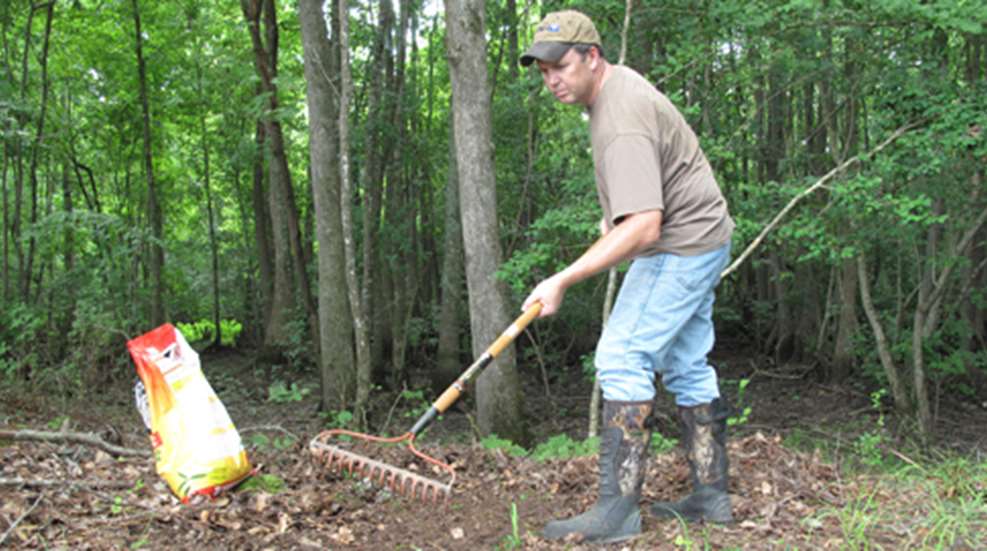
First, rake the area clear of leaves and debris. If grass and weeds are growing, pull them from the ground or spray them with a weed killer such as Round-Up before churning them into the soil. (When using Round-Up or a similar weed killer, be sure to wait a week or two before planting seed.) The ultimate goal is to provide a good open area of soil, ideally no more than 20 yards by 20 yards in size, for planting.
Once the soil is ready, rough it with a hoe or cultivator. If putting lime and/or fertilizer down, broadcast it over the area and rake into the soil. For maximum benefit, give it a few days to work into the soil before planting seed. However, if time is an issue, most wildlife blends can still be planted immediately after the soil is fertilized. Broadcast seed evenly across the open surface. Then lightly drag the ground with the rake or hoe to provide good seed-to-soil contact. Never plant seeds deep or cover them with a thick layer of dirt as this will hinder, if not eliminate, their growth.
Most fall plantings should be done in late August or the early part of September, depending on where you live, in order to allow plants to mature and serve as a good attractant once the season arrives. Plant too early, and small plots can be over-browsed before you ever get a chance to hunt them. Plant too late, and early frosts can kill the plants before they ever mature. You also want to plant seeds when rain is expected in the next day or two. This ensures a good jumpstart to the plot’s overall growth. If planted properly, most seeds should sprout within a week, providing that first hint of attraction that will pull deer beneath your stand in just a couple of short months.