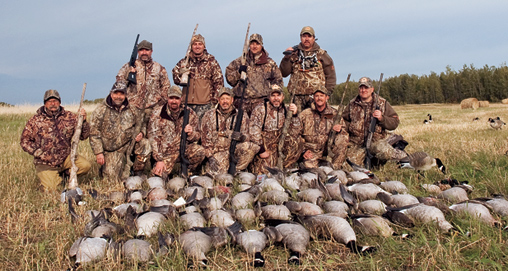
Last year I learned what all the fuss is about. I learned why some guys travel cross-country—heck, out of country—to shoot at birds. I learned to appreciate those rare moments before dawn when all the work’s done—when blinds are arranged just so and when, even though you can’t see them, you know the decoys are spread before you in the darkness in just the right pattern for this wind on this day. And I learned to soak up the bond found among men chatting it up amid sips of warm coffee before shooting light.
Full disclosure: I’m not a waterfowler; didn’t grow up doing it, didn’t grow up dreaming about it.
If it didn’t have horns I never saw the point. I mean, they’re just birds, right? Oh, sure, sometimes the shooting can be hot and heavy. But in my limited experience I’d never seen the kind that would lure me back time and again.
Then I traveled to Manitoba to hunt Canada geese, mainly because every waterfowler worth his salty waders told me I had to experience such a hunt at least once.
Big Birds, Big Limits
“Here, we need to fill out these blinds like this,” said John Vaca as he stuffed a handful of alfalfa into one of the many loops on a layout blind before sunrise the next morning. He’s a pro-staffer with Final Approach, and he discovered this spot a couple hours north of Winnipeg on Lake Manitoba a few years ago.
“These things have lots of loops—fill ’em all up,” he said as he tossed a blind my way and spun on his heel. “We’re gonna be laid out in a line here,” he said, pointing toward a row of cut crops illuminated by the headlamps of the trucks. “We need to look like we belong here. There’re 11 of us, so it’s got to look good. So some guys work on that, the rest of you start grabbing decoys—we’re spreading them in front of us. I want the birds to come in over our heads and land in front of us.”
I shined my headlamp in the trailer. What hunter doesn’t like gadgets? I thought. Here’s a truckload of ’em. There was also a load of work, which explained why we started early. But we were done 30 minutes before legal light, which gave us time to shuck and jive, and wonder what the day would bring. Someone pointed to the North Star.
We were getting antsy about the time someone said, “Wait, what’s that? One’s coming in. Is it time? Who’s got a watch? Can we start shooting?”
“Yep,” came a reply.We buttoned up about the time a solitary honker glided into our setup, and paid the price for it. John Mullet, senior product manager of Bushnell Outdoor Accessories, which owns Final Approach, fired one lone shot, then climbed out of his blind to retrieve the bird. I sat up and watched him among the decoys, backlit by the rising sun—a beautiful picture. “Dude, get your camera,” I said to myself.
Vaca craned his neck to see behind us: “They’re comin, boys,” he clamored as he waved the flag in his hand to be sure the flock saw us, then hunkered down and blew one of the calls on his lanyard loaded with leg bands from across the continent. Soon, a flight of Canadas swooped in from behind us and cupped their wings. “Take ’em,” yelled Vaca. And the shooting began.
It didn’t end for 90 minutes, because, as Vaca had promised, the birds kept coming. No sooner did we shoot at one flock and reload before another was above us, seemingly begging to join their brethren in the decoys. I had a blast, literally, but I’m not sure I accounted for many birds at first.
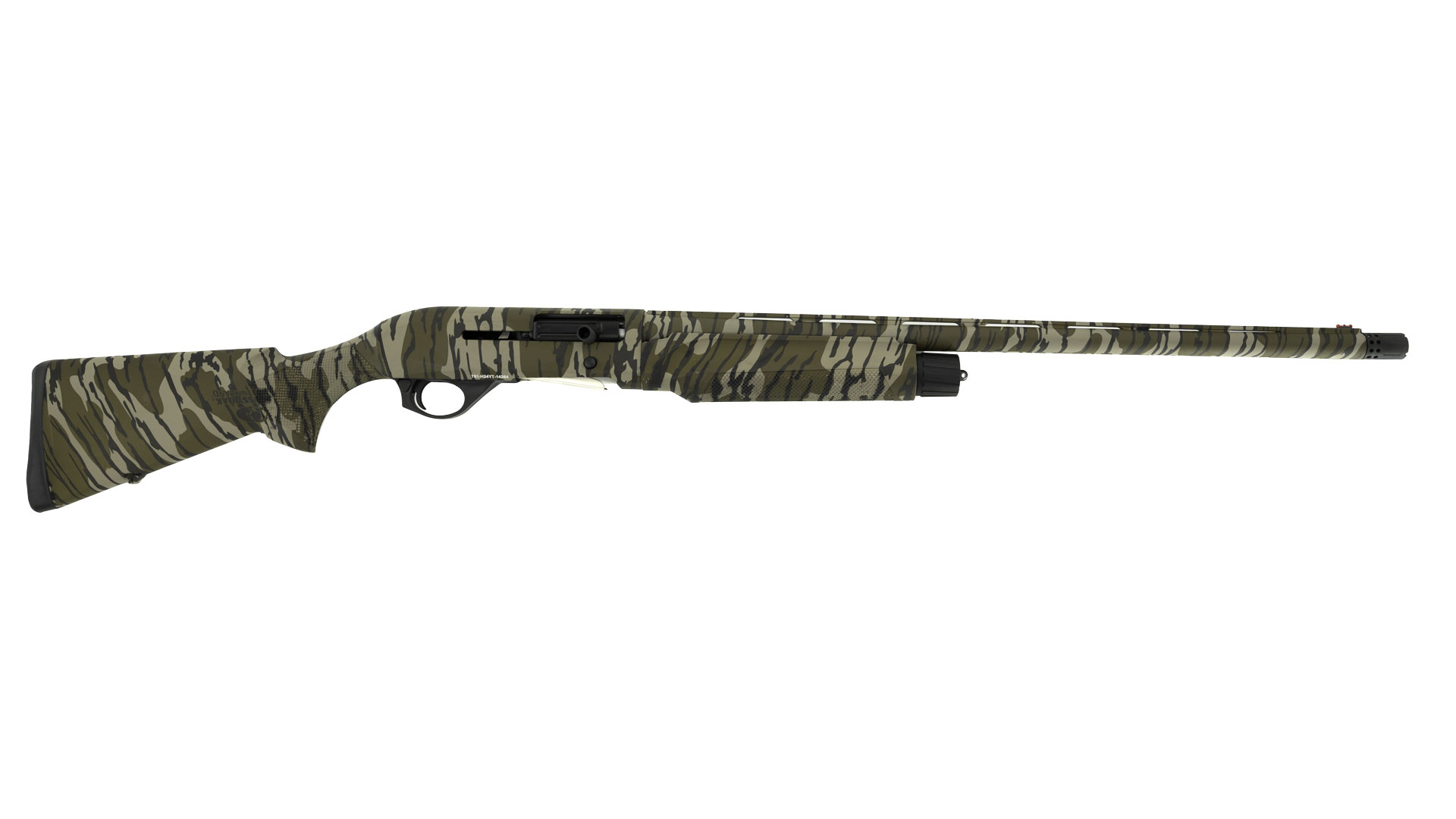
Then I got smart: I thumbed the Speed Unload lever on the Browning Maxus in my hands, shucked out the BB load of steel and replaced it with a 3-inch load of Winchester Supreme Elite HD—the good stuff. The next flock seemed to hang around forever, and the shooting was intense.
As it ended, one bird glided toward the horizon without gaining altitude, which elicited a string of vain shots: Boom! Boom-boom! I joined the broadside, and was surprised when the bird fell. Did I do that? Thereafter I stoked my gun with the good stuff.
Another string of fire seemed to last forever. Boom! Boom-boom! Boom! As geese thumped to the ground I heard someone shout, “There’s a drake woodie!”
A great chorus of “Oohhs” and “Ahhs” accompanied intensified shooting: Boom-boom! Boom! Boom-boom!
I watched in amazement as the bird flew our gauntlet. The little bugger had come in low from our left, flying the length of our line amid flak from Browning anti-aircraft guns. After having a rather easy time hitting giant Canadas for the past hour, it seemed no one could hit the little guy. Boom! Boom-boom! Boom! I began to wonder whether I should root for the bird. It gained and lost altitude with seemingly radar-like prescience to avoid the dreaded shot. Then, at the end of the line, when all thought the drake was safe, Mullett spun on his haunches and dropped it over his right shoulder.
“Hooray!” we shouted in unison. “We got the drake! We got the drake!”
“Let’s see it,” someone said. There, in the palm of Mullett’s hand, laid a most beautiful bird.
“Wow. Look at the colors. What’s he doing up here? How’d you hit him, John? He was practically behind you.”
It was time to celebrate, to honor the little bird that thought it could. And it was time to celebrate the geese, too, to take stock of our haul. These were giant geese, the real McCoy, not the resident mall carp that stop traffic in suburbia.
After one more volley we’d hit our limit, which is five geese per man, per day. There were 11 of us. And we’d hit our 55-bird limit in 1 hour, 45 minutes.
I wish I could say we did the same thing the next morning, but the birds didn’t cooperate and I soon became drowsy. I stretched out high and dry inside my layout blind, even though our line lay amid a row of tall, marshy grass between two crop fields, and caught some shuteye. Between sporadic bits of excitement, I left my ear plugs in, buttoned up, closed my eyes and listened to faint talk and occasional honks, popping up every now and then to fire at the few birds that cupped and dropped.
Morning No. 3, however, was business as usual, which is to say it was a doozy. Like I said, the limit here is five geese per man, per day. Our 11-man crew limited out in 45 minutes. I soaked it all in, finally understanding the fascination with such sport. Back at the lodge, it was as if 11 of us had returned to elk camp with 6x6 bulls. The talking and the chuckling didn’t stop until each of us sat alone on airliners headed for home.
Bears, Too
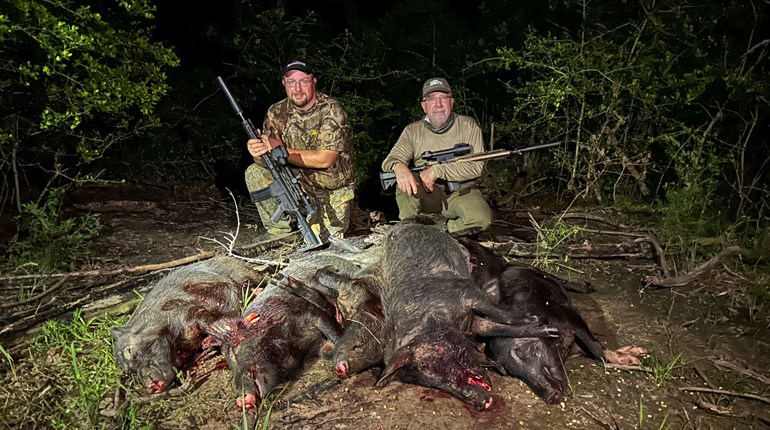
A handful of us hunted black bears, too, during our stay. From a previous trip here I knew they were thick as thieves, so I knew I could count on seeing one or two on stand, even if I didn’t shoot one. I figured that’d beat fishing or watching Canadian football.
Still, I had to wonder about my sanity as I climbed into my stand amid a steady rain with my Browning Maxus now stoked with 3-inch Rackmaster slugs. It’s not the way I would prefer to hunt bears at dark over bait, but hey, I was hunting bears. How bad could it be?
A narrative of the first evening answers that question.
Late in the evening nothing was stirring in the rain and it was too dark to put the shotgun bead on anything black anyway, so I stood up to stretch. That’s when I saw a bear in the brush behind the bait barrel. I figured I’d watch a show until our big, dark-haired Viking-like outfitter, Blair Olafson, came to get me.
In short order the bruin pushed over the barrel and did its best Russian bear circus tricks atop it. It was intent on getting something to eat until a big boar lumbered into the setup and looked right at me. The little fella skedaddled; I was stuck in the tree, in the dark. All the bears here—despite what outfitters will tell you—know exactly where the stands are located. I figure the little ones haven’t been shot at, so while they know sometimes a human sits aloft and watches them, they’ve yet to dodge bullets so they don’t worry. And I figure the big ones are smart enough to think they can take a chance because, hey, they’ve made it long enough to grow big. Still, it’s no turkey shoot; you won’t kill any bear over bait without equal doses of patience and luck. Fact is, these bears are not intimidated one bit by the presence of humans.
After only a couple of minutes the big boar lumbered off, and I figured I’d never see it again. Until 10 minutes later when I realized it was watching me again over my right shoulder. This time it stared right at me. It took a couple steps, stared some more, took another couple steps … then it was near the base of my tree. I thought I’d shift so at least I could raise the gun should it actually begin to climb the ladder (yes, they do that). But it must’ve seen or sensed my movement, because it wheeled and ran.
In another tree not far away, Paul Wait, editor of Wildfowl, sat on his first bear stand. He left his camera bag at the base of the tree because there wasn’t enough room for it in the stand with him. Bad move. Not long after he climbed up, a little bear appeared at the base of the tree, sniffed around, zeroed in on Paul’s bag, grabbed it and ran. Hell, thought Paul, my passport’s in there!
The only thing he could think to say was, “Hey, stop!” Which worked, because the bear dropped the bag and continued running. Paul didn’t know whether to climb down and get the bag or sit and hope for another bear to come into the bait. The decision was made for him when a beautifully big boar lumbered up to the barrel, and Paul’s bear hunt ended. Talk about beginner’s luck.
He told me all this in the truck as we drove to pick up Ralph Lermayer, editor of Waterfowl & Retriever. Paul was just finishing his story as Blair disappeared into the darkness on the ATV to pick up Ralph when the phone in the cab rang. Paul picked it up and said, “Uh huh. Okay. Uh huh. I’ll tell him.”
“What was that about?” I asked.
“That was a lady at the lodge. She said some guy named Ralph called and said to come get him.”
“Maybe he got a bear,” I said.
“Doubt it. She said Ralph yelled, ‘Emergency! Emergency!’ before she lost his signal.”
Just then two shots rang out in the darkness. Which prompted visions of the little old lady in the commercial: “Help, I’ve fallen and I can’t get up!”
“Maybe Ralph fell out of the tree,” I said. “I hope he’s okay.”
Moments later Blair returned with Ralph, who was more than a little excited as he climbed into the back seat.
“Wow,” he exclaimed. “Wow.”
“What? What?” Paul and I asked in unison.
Ralph was in a two-person stand amid four trees—one supported the ladder, the others behind him were close enough to touch. At dark, he heard scurrying behind him and figured it was a raccoon or two. Then he heard a bleat, and more scurrying, only this time it sounded like claws on bark. When he turned around two bear cubs stared him in the face at arm’s length. Then he looked down and saw mama glaring up at him. For whatever reason, she’d sent the cubs up the tree into Ralph’s face, and now she obviously realized the error of her ways and wanted them back.
“So what’d ya do?” I asked.
“I didn’t know what to do,” Ralph answered. “I didn’t like seeing those cubs next to my head. And I just knew the sow would figure it out. And I didn’t want her coming up there after me. So I fired a shot over her head. And it did nothing; didn’t phase her a bit. That’s when I got on the phone to the lodge: ‘This is Ralph,’ I shouted. ‘Emergency! Emergency!’ Then the phone went dead.”
“Yeah, that’s when we came in,” offered Paul.
“Yeah,” said Ralph, “so then I fired two more shots, and still, nothing. Then Blair pulled up, and that did it. She coaxed those cubs down and they all hauled butt.”
Now it was time for Paul and I to exclaim, “Wow. Wow.”
And when we returned to the lodge we learned Kevin Howard heard scurrying behind his stand, too. He craned his neck and saw it was a decent bear. He sat still and waited, figuring it would come into the bait. He heard nothing for a long while. Then he heard a thump and felt a push; his stand was shaking. He looked down between his legs to see the bear standing on its hind legs leaning against the ladder and giving it hell.
“I figured if it started up the ladder I could shoot between my legs,” said Kevin, chuckling. “But I didn’t want to, it wasn’t a big bear. So I just sat there until it decided it’d had enough. I figured I had the best story till I heard everyone else’s tales.”
Epilogue
This wasn’t my first trip to Manitoba. I hunted spring black bears there over bait in 2000. But it was clearly the first time I’ve been bitten by the goose-hunting bug. I don’t think it’ll be the last. And I hope it isn’t the last time I hunt Manitoba. Besides geese and bears, the province offers fabulous fishing and hunts for barren ground caribou, moose, whitetails and, believe it or not, elk.
Contacts
Travel Manitoba, the provincial tourism authority, likes to say it offers “unreal outdoors,” and from what I’ve seen in two trips up there I’d say that’s pretty accurate. The tourism and natural resources departments have made a fresh commitment to get the word out on everything Manitoba has to offer, and their website is the starting point for adventure.
We stayed at Narrows West Lodge, a couple hours north of Winnipeg. Owner and outfitter Blair Olafson does a bang-up job offering just about anything any outdoor-type could want—goose hunting, bear hunting, walleye fishing, boating and more. He has 10 lakefront chalets for rent; six rooms in the main lodge; a campground; restaurant and lounge; marina; gas bar; store with bait and tackle; and more.