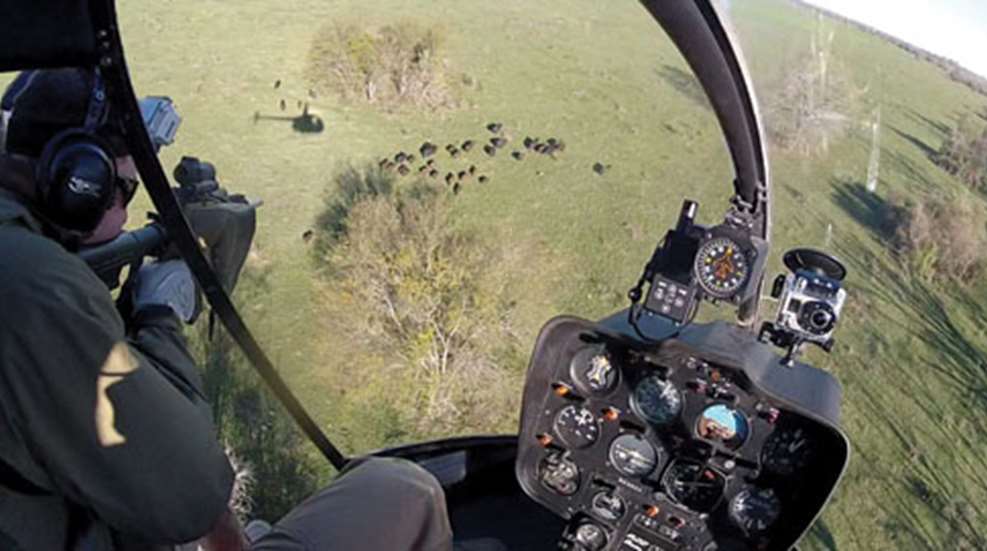
Fifty feet below me, the greening East Texas undergrowth suddenly came alive with hogs. A passel of porkers interrupted from their morning root-and-wallow session beneath the canopy of budding cottonwoods and oaks surged through the swampy forest, jostling shoulder-to-shoulder before lining out snoot-to-ham and weaving among the tree trunks like a giant, mud-splattered snake. Had I been on the ground, they would have been out of sight in seconds—had I even seen them in the first place. But these hogs weren’t getting away. Flying above them in a speedy, single-rotor helicopter gave me a bird’s-eye view of their movements and a means by which to head off their escape. I had a distinct, aerial advantage.
An enthusiastic howl from pilot Mike Morgan blared through my headset. “Get ready,” he said. “This is what we’ve been looking for.”
I leaned farther out the chopper’s cockpit and shouldered the Rock River LAR-15, tilting my head to look around the Aimpoint Comp M4s red-dot to do a quick count. Sixty-some hogs were about to clear the trees and break out into an open field, where the shooting would start. My mission was to kill as many as possible.
Hogs have an excellent sense of smell and hole up in places during daylight hours that are nearly impossible to penetrate on foot. Taking to the air overcomes both obstacles.
A helicopter allows depredation gunners to efficiently scour thousands of acres in a day searching for hogs. The dark, tangled lairs that normally provide refuge to secretive swine when the sun is up can be surveyed from above, which is easier and more effective than slogging through brush hoping for a quick shot. Hogs can’t outrun helicopters, either. Where before a hunter using traditional ground-based tactics was lucky to take two or three hogs from a group, a shooter in a chopper can down a dozen or more.
So effective is heli-hogging that Gov. Rick Perry signed the Texas Hog Depredation Act—the “Pork Chopper Bill”—into law last summer. The NRA-supported measure allows properly permitted landowners and helicopter owners to contract with third parties in controlling the feral hog population under authority of the Texas Parks and Wildlife Department. In short, clients can pay for the opportunity to shoot hogs from the air in Texas, eliminating the method’s extensive costs to landowners and helping to combat the swine scourge.
Aerial depredation control is nothing new; it’s been used across the country for decades to manage wildlife populations when other techniques prove ineffective. Most of the time participation is limited to government agents or contractors. The Pork Chopper Bill changes that by making the method—and the unique experience that comes with it—accessible to the average shooter.
Not surprisingly, the popularity of shooting hogs from the air has the potential to grow as quickly as the population of porkers itself. A number of helicopter owners-turned-outfitters offer aerial hog shoots, which is how I found myself skimming over the Texas treetops in a tiny Robinson R22.
“Shooting from a helicopter is unlike any type of shooting you’ve done before,” Morgan told me during a safety class the day before. “Everything is constantly changing. Your heart rate will go up and you’ll get tunnel vision because you’re going to be excited. But you have to remember to be safe.”
I learned to keep the muzzle of the rifle pointed down, away from the rotor whirling overhead, and to be mindful of an ever-changing field of fire as the chopper banked left or right. Another important safety tip: Don’t drop anything outside the cockpit, as it could be sucked into the tail rotor. And, of course, I wanted to make absolutely sure I was securely buckled to the seat. Despite shooting from a platform that was always moving, I perforated 3-D paper piggies during the safety course enough times to be considered qualified for the real thing.
The next morning Morgan took me up with the rising sun. Running hogs, a moving helicopter and quickly changing angles made for difficult shooting.
Twenty minutes into the flight we were into the largest group of hogs I had seen in my life. Rather than having me shoot at the hogs as they ran through the woods, where a screen of limbs and leaves could render fire ineffective, Morgan told me to wait while he used the chopper to drive the charging group into an open field. When they hit the grass, I flipped the safety and went to work.
I picked out a rust-colored individual, drove the Aimpoint’s glowing red dot behind its shoulder and pressed the trigger. Dirt flew behind the hog, telling me the 60-grain Hornady V-Max impacted high and to the left. Another shot and more dirt said “high and behind” again. The range was less than 20 yards, but I missed several more times before I remembered to keep the gun tracking with the target and finally connected.
Morgan brought the chopper lower, flying over the group to its front. A big boar leading the pack soon filled the optic. After a few misses, I put a bullet into its ribs. A quick follow-up slammed into its neck. Its head dropped, its legs folded and it skidded several feet along the ground before stopping.
By then most of the hogs had turned toward the safety of the trees so Morgan banked the chopper to cut them off. I used the lull in the action to reload, because within seconds the pilot had chased the herd back into the field. A sow dropped then a few skinny 40-pounders. I picked my shots but did not discriminate. This was not a trophy hunt, not a hunt of any kind; this was population control. Every hog was fair game.
Four minutes later, Morgan and I counted 18 dead hogs. The flight proved the aerial approach is certainly effective. It’s fast-paced, challenging—and the view from above and the feeling of floating in air make it invigorating. Dare I also call it fun?