I remember when hitting a gallon can with a slug-shooting shotgun three straight times at 40 yards defined a tack driver. All that changed with the advent of rifled barrels and sabot slugs in the late 1980s. From that point to the present, slug shooting has taken a quantum leap forward from the 40-yard “maybes” to the point where the modern slug hunter, armed with a state-of-the-art bolt-action shotgun like the Browning A-Bolt, can’t be faulted for pre-heating the oven when antlers appear 200 yards away.
A False Start
The A-Bolt was introduced in 1994 when a synthetic-stocked version was seen in the Browning booth at the SHOT Show in Dallas. It was chained to the wrist of an Asian gentleman who represented the Japanese ordnance giant Miroku. The prototype left Dallas chained to the same wrist, and it didn’t reach dealers until March 1996. (The delay was attributed to Browning’s “fine-tuning” of the specifications. The widely held assumption, however, is that the manufacturer had design problems with shell feeding—a concern when trying to cycle a bulky, non-tapered hull.)
The resulting A-Bolt—essentially the company’s A-Bolt centerfire rifle design chambered for 12-gauge–is considered to be one of the best quality production slug guns ever made. But Browning simply couldn’t sell enough of them in the presence of other, fairly accurate rifled-barrel bolt-actions from Mossberg, Marlin and Savage for half or even a third the price. So the A-Bolt shotgun was discontinued due to poor sales in 1999 when the gun’s five-year production contract with Miroku expired.
Bolt-Actions Today
The Mossberg and Marlin bolt guns were similarly discontinued a few years later when sales lagged. Only Savage soldiered on, producing less than 9,000 of its 12-gauge Model 210 bolt-action shotguns annually. Last year Savage redesigned, and markedly improved, its bolt-action offerings with the 20-gauge 220F and 12-gauge 212. Browning, meanwhile, had long been having second thoughts on the early dismissal of the A-Bolt design. The quality slug gun that they simply couldn’t sell in the late 1990s for $700 was, by the 21st century, selling on the used gun market for $1,500-$2,500.
Thus, in 2011 Browning/Miroku reintroduced the walnut-stocked A-Bolt Hunter, albeit for a $1,200 price tag ($1,100 for the synthetic-stocked Stalker model and $1,240 for the camo version cloaked in Mossy Oak Break-Up Infinity). It was probably inevitable that the bolt-action gun would re-emerge in this renaissance of slug shooting. After all, like arrow speed in archery, lane grip in bowling and shaft flex in golf, accuracy had become the Holy Grail sought after by slug shooters.
Anybody knowledgeable about slug guns knows that a solid lock-up, a heavy, free-floated barrel fixed to the receiver and a quality trigger are critical to accuracy. Thus the hottest ticket in slug-gun shooting today is the bolt-action, which boasts all three. The A-Bolt is no longer available in a smoothbore version, as was the alternative in the 1990s, and the rifled-barrel version is now fitted with adjustable TruGlo rifle sights. Otherwise, the new Miroku gun pretty much mirrors the old design—which was terrific.
The New A-Bolt
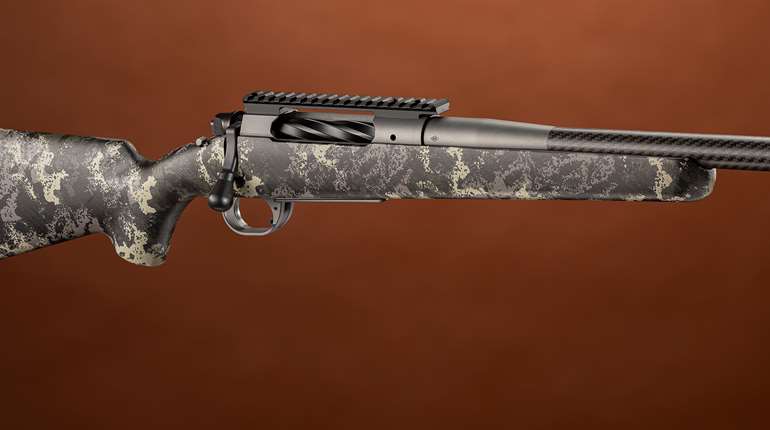
The A-Bolt design features a three-lug, front-locking rifle-style bolt with a neat 60-degree throw, a free-floating, 22-inch rifled barrel, and a receiver that’s drilled and tapped to accept a scope. The A-Bolt’s 12-gauge, right-hand rifling twist is the widely adaptable 1:28-inch, which is particularly well-suited for the high-velocity (1700 fps muzzle velocity and higher) slugs that rule the market today. The 7-pound gun features a detachable, two-shot metal box magazine that can be affixed to the hinged floorplate.
In addition to the locking lugs on the bolt head, the A-Bolt features a large hook extractor that pulls the shell case against an ejector stud in the left rear of the receiver. Spring-loaded shell guides in two of the lugs help maintain the extractor’s grip. The front-locking bolt, like the rifle design, turns within a sleeve that remains stationary while the bolt rotates in and out of battery. The extractor is a slender, hook-like affair that rotates with the bolt head and is housed in a slot just above the bottom locking lug. Extraction is via inertia; a blade contacts the case rim through a slot in the bolt head as the bolt reaches the last half-inch of travel.
At the Range
The long ejection port inherent in bolt-action shotguns poses a problem when attempting to mount a shotgun-style scope on this gun. Using two-piece bases (Weaver 47M for the front and Weaver 419 for the rear), the space between rings was too great to fit between the bells of a compact scope. In fact, the tube bodies of the Nikon SlugHunter scopes I regularly use were 1/8-inch too short. A search of the optics closet, however, found a Kahles American Hunter 2X-7X-36mm that complemented the gun nicely in medium-height Weaver Grand Slam rings.
Using 3-inch Winchester Dual Bond 23/4-inch Remington Accu-Tip, 23/4-inch Hornady SSTs and 3-inch Lightfield Hybred Elite sabots for the 100-yard test provided a good idea of the gun’s accuracy potential.
Shooting five, three-shot groups at 100 yards with each slug from a Caldwell Rock BR rest, the A-Bolt grouped 375-grain Winchester Dual Bonds to an average of less than 1.37 inches and 546-grain Lightfield Hybred Elites to virtually identical dimensions. Hornady’s 300-grain SSTs grouped an average of 1.86 inches and Remington’s 385-grain Accu-Tips—designed as they are for the SAAMI (and Remington) 1:35 twist rate—at 2.2 inches.
The A-Bolt cycled very smoothly—a trait that’s still unattainable by some other bolt-action shotguns—but one should expect as much of this $1,000-plus gun. The wide-shoed, grooved trigger broke crisply at 3.14 pounds on an average of 10 shots with very little variation.
All in all, it was like welcoming back an all-star player from retirement.
Specs:
browning.com
Type: bolt-action, shotgun
Gauge/Chamber: 12-ga./3"
Barrel: 22"; button rifling, 1:28" RH twist
Trigger: single-stage; 3.14-lb. avg.
Magazine: detachable box affixed to hinged floorplate; 2-shot capacity
Sights: TruGlo/Marbles fiber-optic front sight; adjustable rear; drilled and tapped for scope
Safety: tang-mounted slide
Stock: walnut, satin-finish (tested); synthetic; LOP, 14"; drop at heel, 5/8"; drop at comb, 1/2"
Overall Length: 43.75"
Weight: 7lbs., 2 ozs.
Metal Finish: blued or camo
MSRP: $1,270 (Hunter); $1,160 (Stalker); $1,270 (Mossy Oak camo)