Young hunters were spared the frustration of shooting waterfowl with the first steel loads introduced when nontoxic shot was mandated for waterfowl hunting 20 years ago. The steel pellets from those loads were so feeble they’d bounce off a balloon at any distance. Well, maybe I’m exaggerating, but no doubt waterfowl hunters learned that when it comes to steel, speed kills. In the years since, improvements in wads and propellants have significantly increased steel load velocities. The latest improvement to steel shot is to the shape of the pellets.
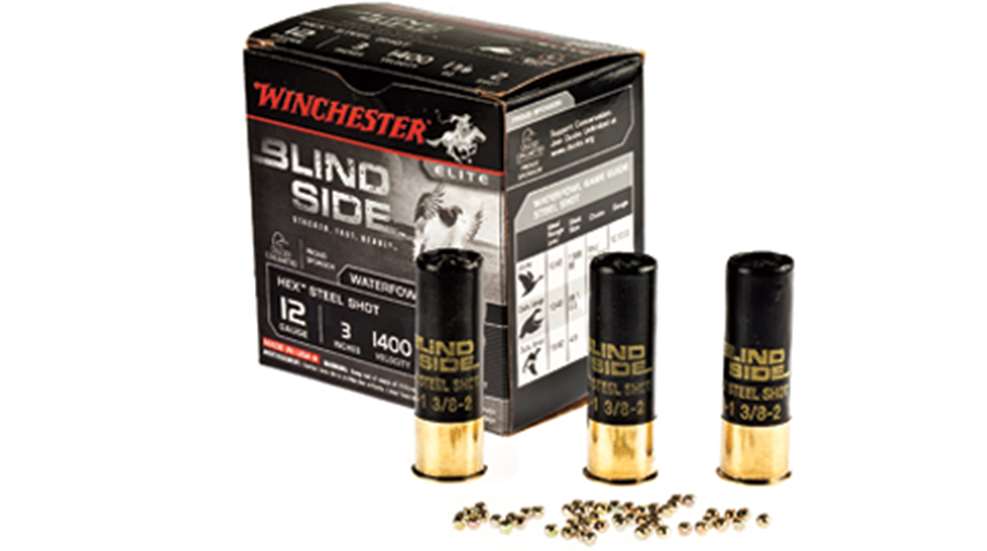
Winchester Ammunition incorporates many of those improvements in its new Blind Side steel shot loads. The six-sided shot is supposed to hit ducks and geese harder with high velocities and tighter patterns.
Hex Shot
Shotgun experts have lectured forever and a day that hard and round shot is required for tight patterns. That certainly has been proven with regular steel shot loads that keep 80 percent or more of their pellets in a 30-inch circle at 40 yards when fired through modified and even improved cylinder chokes.
Winchester claims its six-sided Hex Shot flies through the air like tumbling bricks, yet it patterns tightly. Hex Shot is not very aerodynamic, and uneven air resistance against it would cause it to pattern like a herd of cats—if the shot was fired with a regular wad comprised of front-opening petals, which flare to release shot as soon as the charge clears the muzzle. However, Blind Side’s Diamond Cut wad holds the Hex Shot inside the shot cup several feet past the muzzle when three petals near the base of the wad deploy comparatively slowly to pull the wad away from the shot charge. When patterning Blind Side and other steel loads, I found the Diamond Cut wads on the ground 10 yards farther from the muzzle than regular steel shot wads.
Blind Side patterns tightened up with increased choke constriction, something absent with regular steel shot. Pattern percentages were right in line with choke specifications when I shot Blind Side 12-gauge, 3-inch, 13/8-ounce loads of Hex steel 2’s through three different choke tubes. That means a hunter using an improved cylinder choke can fire wide patterns for some aiming leeway when ducks plummet with corkscrewing turns into his bobbing decoys. Then he can screw in a full choke for tighter patterns for long-range pass shooting when geese are flying with someplace else in mind.
When shooting the Blind Side load, a few of the Hex Shot pellets that hit outside the 30-inch patterning circle landed near the outer edge. However, most of the pellets that flew wide did so by a foot or more.
Penetration
Winchester states that its Hex Shot hits waterfowl like “high-velocity tumbling bricks, delivering massive wound channels that maximize energy deposit and knock-down shock within the bird.” I guess. But after 44 seasons of hunting ducks and dressing ducks I have rarely seen a pellet wound path that looked like it had been caused by an “energy deposit.” Even the softest lead shot of yesteryear expanded to deposit its energy only if it hit a wing bone. Pellets, whether they are lead, tungsten-based or steel, kill ducks by penetrating to puncture the lungs or heart or break major bones.
I shot Blind Side 12-gauge, 3-inch, 13/8-ounce loads of Hex Steel 2’s into blocks of ballistic gelatin at 40 yards to determine if the flats on the pellets created any sort of a wound channel, or if the multiple edges increased penetration. Of the 10 or so pellets that hit the blocks, penetration was fairly even at a depth of 5 to 5.5 inches. As expected with such small projectiles, there was no discernable sort of a wound cavity along the pellets’ paths.
In comparison, penetration was 4.5 to 5.5 inches into the gelatin shooting Winchester Supreme High Velocity 11/4-ounce, copper-plated steel 2’s at 1450 fps. Again there was no visible hollow along the pellets’ paths.
Stack ’Em Up
The flats of the Hex Shot allow the pellets to stack tightly against and on top of each other in the shot cup. That reduces air space between pellets with a resulting relatively short shot column. The shot column of 13/8 ounces of Blind Side 2’s is about the same height as 11/4 ounce of regular steel 2’s. I figured Winchester used magnets during the loading process to align the pellets in such a compact stack. But Brad Criner, Winchester’s senior product manager, held up a clear plastic tube containing a jumble of Hex Shot. As he shook the tube the slight vibration aligned the pellets atop each other in a more compact column.
That shorter shot column allows loading more shot in a shell for a denser pattern or extra powder for higher velocity. Winchester has loaded additional powder in that extra space because the stated 1400 fps velocity is as fast as any manufacturer loads 13/8 ounces of steel in a 12-gauge, 3-inch magnum shell or 15/8 ounces of steel in the 12-gauge, 31/2-inch shell. The 2 and BB in those loads are all of Blind Side’s offerings for its first year. But with the additional room in the shell Winchester will no doubt expand its Blind Side loads to include lighter amounts of Hex Shot at even higher velocities because, as waterfowl hunters have learned, speed kills with steel shot.
These continuing improvements in steel shot loads mean a waterfowl hunter’s shooting skill is the main factor in his success. Winchester is doing its part with its Blind Side steel loads. The rest is up to you.