Jim Van Norman and I climbed a steep, timbered slope in the predawn dark. Hearing the bugling and cow calls emanating from farther down the mountain, we figured it was worth the pain. The previous morning we’d arrived too late to intercept the herd as it made its way from feeding below us to bedding in the thick young firs uphill. This meant we were pretty much out of the game. (Anyone out there who thinks he can outrun an animal walking uphill on four long legs, take it from a couple of middle-aged guys who’ve been there, tried that: It ain’t gonna happen.)
All we could do was try to get one of the 10 or so bulls in the herd to reverse direction by sounding like a lonely cow. That proved to be wishful thinking. When elk are moving in earnest toward their bedding area, more often than not even the most plaintive cow calls won’t turn a bull. It’s best to get out in front—and now we finally were.
Having that many bulls in a herd might seem farfetched to many hunters, but this was early October—the 8th, to be exact—and with the cows starting to herd up for winter, the neighborhood bulls had gravitated toward them. They were looking for the few cows that hadn’t been bred earlier in September to come into season again, or for late-born yearlings to go into heat for the first time. With the rut winding down, the bulls were concentrated.
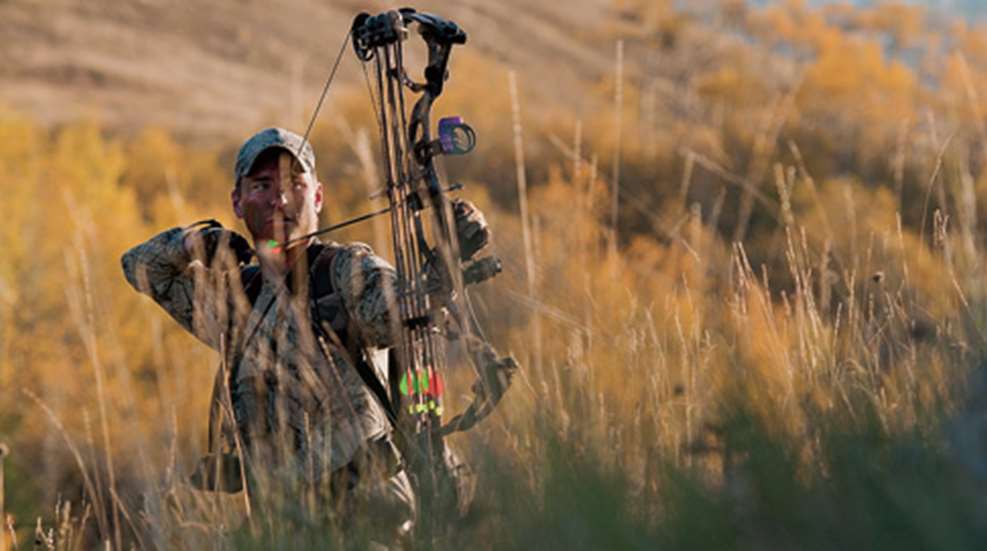
We set up about 50 yards apart and just over a rise so any bull investigating Jim’s cow calls would come in close before wondering where the cow was. With the herd making all sorts of racket, it wasn’t hard to monitor its advance, and soon we could see antler tips going by. Jim’s calls didn’t turn those bulls, but it wasn’t long before I spotted a raghorn sneaking in. Since the season was winding down, I wasn’t going to be choosy. Unfortunately, due to a recent elbow operation my right hand got so painfully cold in the 20-degree air that I didn’t think I could get off a controlled release, so I let him walk by, 30 yards away, on his way toward Jim.
When the bull got within 18 yards, Jim drew back, but noticed that the young bull was looking behind. Knowing another, and probably bigger, bull was about to show, he held off and moments later a 5-point trotted into view. When that bull stepped out from behind some trees, he too turned to look back at another approaching bull. Unlike the raghorn, though, the 5-point wasn’t so lucky, as Jim wasn’t about to test his luck a second time. At the shot the woods erupted in thundering hooves and snapping twigs. All the commotion triggered bugles from three bulls farther downhill, and Jim motioned for me to take off after them; he’d trail the 5-point he’d just hit.
A half-hour later I found Jim standing near his bull. I couldn’t help but smile. Any morning you or your partner puts a bull on the ground is an awfully good one; when you’ve also been that close to so many others, it’s flat out phenomenal. Though I’d always had good success hunting in late September, unlike Jim, I’d never bowhunted elk this far into October. It was as good, if not better, than my favorite time to bowhunt elk—the pre-rut.
Benefits of Hunting Early and Late
Most bowhunters think the peak of the rut—roughly the third week of September here in the Rocky Mountain West—is the best time to hunt elk. No doubt you’ll hear lots of bugling then, which if nothing else helps you locate bulls. And who can complain about lots of bugling? You also have a good chance of lucking into a herd bull fending off numerous satellite bulls trying to steal a cow that’s come into heat. It’s a pure adrenaline rush if you can sneak in among them, and one of the best opportunities to kill a nice bull.
But the peak has its downsides, too. Not only are most hunters going to be out there with you—a huge disadvantage—you also have the frequent problem of dealing with herd bulls whose first instinct, after bugling to your calls, is to flee with their cows from what they perceive as competition. They can also be tough to entice with cow calls. The old saying that a bird in hand is worth two in the bush applies exponentially to a bull with three to 20 cows. He might come to a cow he believes has wandered off, but he also knows that if he leaves his harem even for a few minutes, he might be short a few—or all—of them when he returns. This time of year a herd bull has good reason to be paranoid.
That’s not to say there aren’t plenty of opportunities with loner bulls traversing the high country in search of cows, or with satellite bulls hovering around herd bulls with harems. But if I had to pick when to take a week’s vacation hunting elk, it would either be early (after opening weekend) or late in the season (some states have limited seasons, so hunting this late might not be an option). You might have to cover more country to find elk, but when you do get their attention, there’s a far better chance of calling in a bull than during the peak of the rut.
■ In late August and early September, bulls are more likely to investigate bugles and cow calls. They’re not herded up like they will be a few weeks later, although you’ll often see younger bulls with cows. Once the cows start coming into heat, however, mature bulls will converge and claim the cows for themselves. Until then, these 2- to 3-year-olds are feeling their oats, and they’ll often reply to calls. So will solo bulls that are getting restless as the rut draws near. They’ll also sneak in quietly to check out other bugling bulls, intent on sizing up the competition but not looking for a confrontation. Perhaps the biggest early-season advantage is the fact that you’re usually dealing with single animals, hence fewer eyes and noses with which to contend.
■ By early October most of the breeding has taken place and the cows are gathering into bigger herds. Hoping to capitalize on the late-season estrous cycle, bulls will converge on these cows from miles away. As more elk gather into a smaller area, they’ll become more agitated and hence more vocal. Finding them can be easy if you’re within earshot; otherwise it can take a lot of hiking to locate them.
■ Of course, you’re still likely to encounter roaming bachelors that will cover a lot of ground to reach a cow, and a desperate bull is usually a gullible bull. Best of all, the elk are apt to be more relaxed and cooperative, since most elk hunters are back in the low country, watching football or hunting birds and deer.
Calling Strategies
Hunting early and late requires decidedly different calling techniques. Early-season bulls can be aggressive and vocal, but on average they require considerable prompting to locate and agitate, especially during hot weather. They can also come in from a half-mile away without making a peep. Locating late-season bulls, by comparison, is easy.
In the early season:
■ Bulls have a habit of sneaking up on you unannounced. Even if you’re not sure elk are in the vicinity, before you start calling, set up where your outline is broken and you have at least a few shooting lanes.
■ If there’s plenty of fresh sign, stay put for at least 30-40 minutes with an arrow nocked, even if nothing answers. If you’re calling to locate elk, don’t be in a hurry to move.
■ Don’t expect even a nearby bull to answer immediately; if the country looks promising—shady, cool, moist, with benches and small basins—call sparingly over five to 10 minutes before moving. A bedded bull might not respond to one bugle; after three or four he might become annoyed enough to bugle back.
■ Cow call a few times before bugling. This time of year, a bull that responds to a cow call is probably coming in.
■ Soft, unaggressive cow and calf calling works best now; leave loud, excited calling and “hyper-hot” calling for later in the rut.
In the late season:
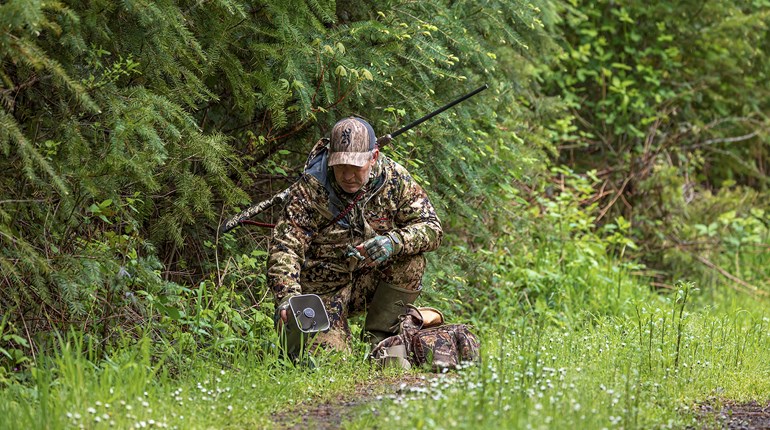
Locating bulls now (October and later) usually isn’t a problem, according to Van Norman, since they’re herded up and extremely vocal. he calls far less than earlier in the season and cow calls way more than he bugles. He will, however, cow call excitedly at times, imitating a cow in estrus to excite bulls frantic to breed. He’ll also calf call a lot, mimicking a lost calf left by its mother who’s off getting bred. With so many bulls concentrated in a small area, the response is often immediate; in fact, unlike during the early season, if Jim doesn’t get a response soon after the herd’s nearby, he’s up and on the move again, trying to outflank the elk so he can set up and try again.
The Right Time and Place
As my hunt with Jim illustrated, the trick to the second rut is mapping out a herd’s established travel route between feeding and bedding sites, then setting up before the elk get there. That means heading out well before first light with a specific spot in mind. Because you’re dealing with a large number of elk, hunting their bedding area is imprudent—there are far too many eyes and noses to evade. More important, you run the likely risk of spooking all those elk out of the country, thereby ruining your biggest advantage—being in the animals’ predictable travel route. For that reason hunting their feeding area is also a mistake.
Early-season bowhunting is far more forgiving, since the elk aren’t congregated and you’re often working single bulls.
■ Given a consistent wind, hunting bedding grounds is an absolutely killer tactic, as good bedding sites are easy to locate (think cool, shaded timber) and the bulls aren’t preoccupied with keeping their harems intact. Also, if you do bump a bull, he won’t take most of the area’s elk with him. Granted, that’s probably one less bull you’ll have a chance to kill, but it won’t signal the end of your hunt.
■ If there’s anything predictable about elk in early September, it’s that they’ll invariably gravitate to the coolest locations they can find. That’s where you need to be. Getting out at 0-dark-thirty isn’t as critical as it is in October, but you’ll be better off if you have ample time to locate and work a bull into range before the thermals start shifting from a steady downward direction to going uphill. Cool mornings and hot days are a recipe for switching winds, and that’s the biggest Achilles’ heel for early-season bowhunters. The earlier you can get on a bull, the less likely switching winds will betray you.
Regardless of whether you live in elk country or have to travel to it, don’t limit yourself to hunting just the peak of the rut. If working responsive, unpressured elk is your idea of a good time, consider the pre- and post-rut.