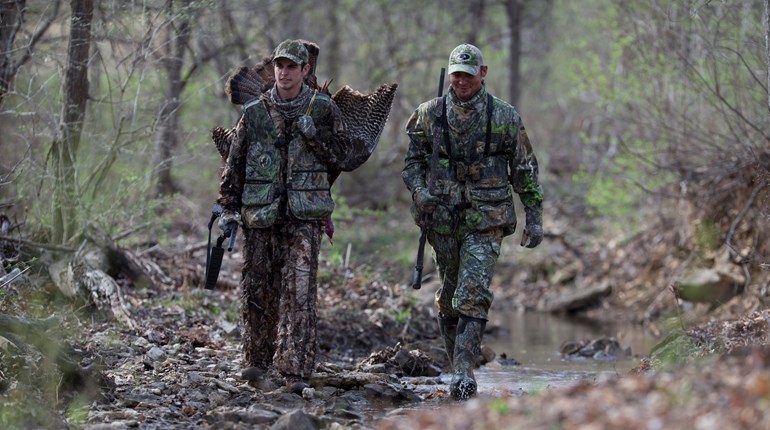
Every spring a realization socks me in the gut. At first, as I stand at dawn 1,500 vertical feet from where I parked in New York’s Catskills, I confuse the feeling with my gasps for oxygen. At that moment I promise myself to run on that oversized hamster wheel (known better as a treadmill) more often the next winter. But soon, as my stomach settles, I realize the surprise is that the gobbles I hear on the public land descending below me aren’t being answered by a cacophony of box calls, slate calls and mouth calls.
Lower down, in the wildlife management areas closer to the towns, my ear has become adept at not just separating turkey talk from forests full of songbirds, but also at telling the guys with the facemasks and friction calls from lanky-necked ones with feathers. Sometimes I’m even certain I can tell not just the type, but also the make and model of calls. “Oh listen to that yelping,” I’ll say to a hunting buddy, “that’s a box call, a Knight & Hale Ole Yelper, I believe.”
Tired of the race to the gobbling turkey, I tried the mountains. For a few seasons I thought it simply good fortune that no one had found my “secret turkey spot.” To find it I’d driven down every country road that meandered near a section of mountains I was interested in. The best area I found is at the end of a fork in a dirt road. When I tried the left fork I dead-ended at a crumpling house. I stopped and got out to see if there was a way past it, but as soon as I closed my truck door two Rottweilers jumped out of a rotting school bus and chased me back into my truck. One of dogs jumped into the bed of my pickup. As I wasn’t anxious to meet the proprietor of the bus, I went, dust flying, back to the fork in the road. The dog came along for the ride and only jumped out when I turned down the right fork. I thought this was a pretty good sign.
The right fork led to the base of a mountain lined with state land signs. I had arrived. This mountain has since given me five gobblers.
In the years since finding that spot, I’ve found there are actually a lot of un-hunted gobblers throughout these mountainous public lands. You just have to know how to dissect the terrain to find the turkey spots.
Where to Go
From the White Mountains in New Hampshire, south over mountain spines to Vermont’s Green Mountains, then south again to New York’s Catskill Mountains and through Pennsylvania and along the Appalachians all the way to Georgia and west into Kentucky mountainous public lands hold gobblers that are rarely hunted. The same can be said of sections of the Rockies and some places in between. If you spend some time perusing topographic maps or on GoogleEarth.com you’ll find you can access good turkey habitat located above farms and housing developments—areas that are mostly locked in by private lands—by climbing over ridges or side-hilling to them in these higher-elevation areas.
These turkey hotspots are disregarded for several reasons. One reason is you have to sweat to get to these birds. But a disdain for calluses can’t be the only reason; after all, in my experience these same places see quite a few deer hunters. Perhaps a bigger reason is turkeys often don’t move up to these higher areas until spring green-up ascends the slopes; as a result, if you scout before the season you may not even hear a gobble from a mountainous area that a few weeks later might be echoing with gobbles.
Another reason is that hunting turkeys in these places sometimes takes an elk-hunter’s resolve to find the game in all the mountains; however, maps can help avoid such heart-attack treks. Look for old, abandoned homesteads and other openings in the canopy that might attract a strutting bird (those white spots on topo maps). Also, look for seeps where springs create feeding areas for turkeys even before other food sources become available in the mountains. Seeps provide turkeys with green forage, tubers, insects and aquatic invertebrates. Check the muddy bottoms of seeps for turkey tracks and strut marks.
As you peruse your maps, check for hard-to-access public areas at the lowest elevation you can get to without trespassing. Many times you’ll be able to hike to roosting sites located above agriculture fields and other food sources.
How to Hunt Mountain Gobblers
The acoustics of mountainous areas can prevent you from hearing gobbling, so before dawn you need to hike up to where you can hear down into as much terrain as possible. One of my best areas has good hunting just above public parking areas, but a roaring stream near the parking areas makes it impossible to hear birds that are just a few hundred yards away. I’m sure many hunters have listened from below, but couldn’t hear the birds over the sound of the stream.
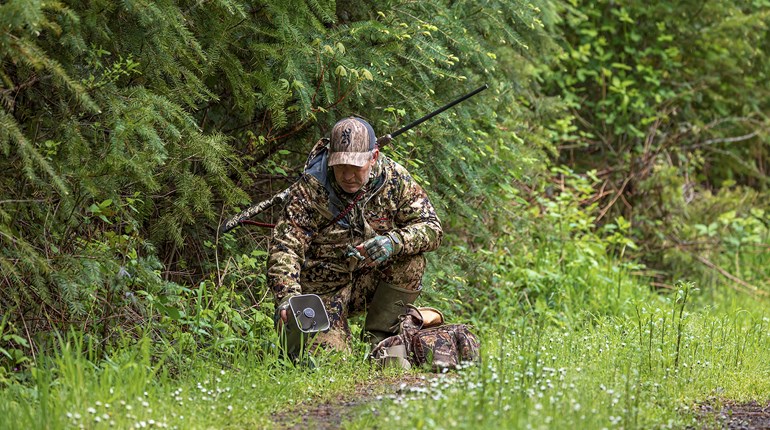
If you hear a gobbler, mark its location and move fast. If you don’t, you have hiking to do. Follow a topography line along a mountain bench and call every 200 yards or whenever you peek into new habitat.
When you hear a gobbler, go after that turkey. Sure, that sounds like common sense, but when you hear a gobbler a mile away on the next hillside it’s tempting to think: I’ll just see if there is a gobbler somewhere on this ridge first. Don’t do that. These birds are spread out. When you find them, go after them.
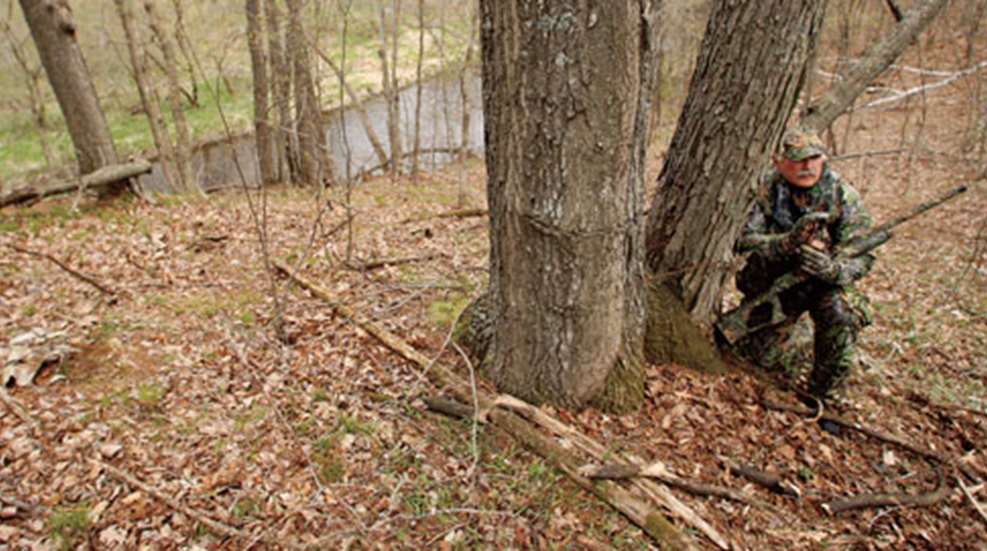
However, be careful. Steep slopes, conifers and drainages can make a gobbler sound farther away than it is. When a tom answers you twice, sit down. That bird will likely come in. If you’re not sure how far away the bird is, sit with your back to a tree and give the bird time. Keep calling. If the bird continues to answer, it’s likely coming. As there aren’t as many turkeys up in the mountains as there are in the farmlands lower down, gobblers can be aggressive.
Also, keep in mind that you’re following spring up the mountainsides. Even when the gobbling is pretty much finished near sea level, often the birds up high are still roaring. In fact, I’ll often concentrate on low-elevation areas until they become too thick and buggy and the birds stop talking. Then I’ll spend the last weeks of the season in the mountains, where I find early spring all over again.